
The inaugration was also attended by the Chief Minister, Shri Yogi Adityanath ; UP Governor, Smt. Anandiben Patel and Secretary, Department of Health Research & DG-ICMR, Prof (Dr.) Balram Bhargava.
Gorakhpur, 7 December 2021: Hon’ble Prime Minister Shri Narendra Modi inaugurated the new centre of medical research excellence at Indian Council of Medical Research’s Regional Medical Research Centre Gorakhpur (ICMR-RMRCGKP) in Gorakhpur on December 7, 2021. ICMR-RMRC Gorakhpur has spearheaded the country’s fight against Japanese Encephalitis in the region and succeeded in reducing the incidence of this life-threatening disease through pathbreaking research and interventions.
The new centre at RMRC Gorakhpur is enabled by state-of-the-art infrastructure, which will further expedite the institute’s efforts to enhance health research in areas of viral, bacterial, fungal, and parasitic diseases. The inauguration was joined by Chief Minister of Uttar Pradesh, Shri Yogi Adityanath; Uttar Pradesh Governor, Smt. Anandiben Patel; and Secretary, Department of Health Research & Director General of ICMR, Prof. (Dr.) Balram Bhargava.
ICMR-RMRC Gorakhpur is the first dedicated biomedical research institute in the Northeast region of Uttar Pradesh. It has played a crucial role in managing Japanese Encephalitis (JE) in Gorakhpur and surrounding areas, which has resulted in the decline in JE-AES cases by 87% in seven districts under the Gorakhpur and Basti division. During the launch, Prof (Dr) Bhargava highlighted the important role of the ICMR-Gorakhpur in leading health research in Gorakhpur. “As the pioneering biomedical research institute in the state, RMRC Gorakhpur is critical in enhancing health research in the region and subsequently ensuring better health outcomes,” Dr. Bhargava was quoted as saying.
The foundation stone of the institute was laid by the Chief Minister of Uttar Pradesh Shri Yogi Adityanath and then the Health Minister Shri Jagat Praksh Nadda. Since then, it has conducted pathbreaking work in developing diagnostics and vaccines for JE/ AES as well as leading COVID-19 vaccination and testing in the northeast region of Uttar Pradesh.
“The new center, constructed at BRD Medical College is equipped with world class facilities aiming to make RMRC- Gorakhpur a State of the Art ‘Centre of Excellence’ for health research and will go a long way in improving the health status of the region,” Dr. Rajnikant, Director, ICMR-RMRC Gorakhpur said.
The Indian Council of Medical Research (ICMR), New Delhi, is the apex body in India for the formulation, coordination and promotion of biomedical research, is one of the oldest medical research bodies in the world. ICMR’s research priorities align with the National health priorities. These efforts are undertaken with a view to reduce the total burden of disease and to promote health and well-being of the population. ICMR promotes biomedical research in the country through intramural as well as extramural research. Visit us at https://www.icmr.gov.in/
RMRC, Gorakhpur is one of the 26 Institutes of the Indian Council of Medical Research (ICMR), under Department of Health Research (DHR), Ministry of Health & Family Welfare of Government of India. Visit us at https://rmrcgkp.icmr.org.in/
Last 10 crores sample testing conducted in 55 days
● Enhanced production of diagnostic kits has resulted in reduction of costs and improved availability of testing kits.
● Number of COVID-19 testing laboratories at more than 2800
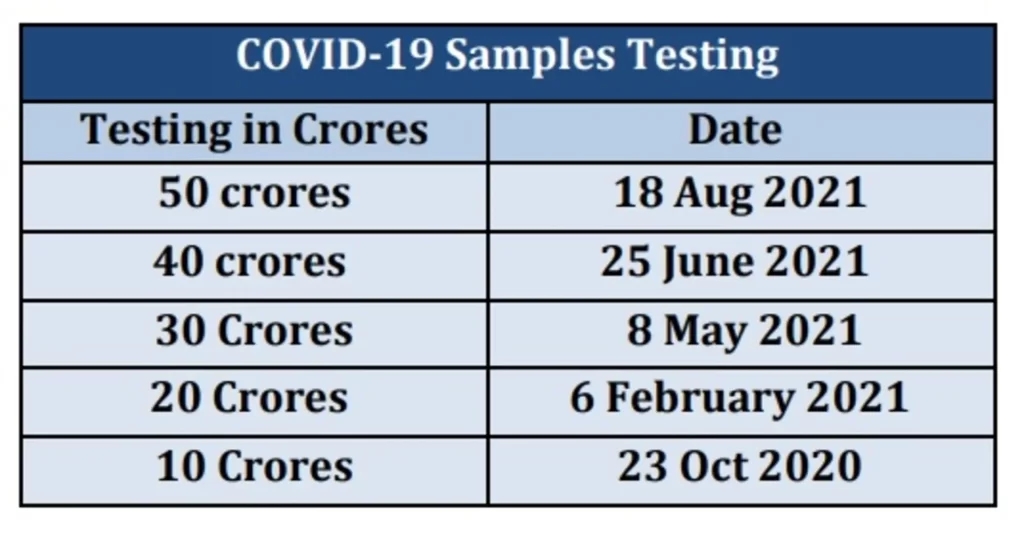
Indian Council of Medical Research [ICMR], the apex body at the forefront of formulating COVID-19 testing protocols in India has achieved the milestone of conducting 50 crores tests on 18th August, 2021. With average daily testing of more than 17 lakhs in the month of August, India has tested 50 crore samples across the country till date.
India has achieved the milestone of the last ten crore tests in only 55 days. On 21st July 2021, India had tested 45 Crores COVID-19 samples, which reached 50 crores mark on 18th August, 2021. This has been enabled by rapidly increasing testing infrastructure and capacity across the country. ICMR has been enhancing COVID-19 testing capability across the country by expanding and diversifying testing capacity by leveraging technology and facilitating innovation in affordable diagnostic kits. The testing strategy has been carefully calibrated to increase access and availability of testing.
Prof (Dr.) Balram Bhargava, Director General, ICMR said, “We have seen that exponential increase in testing led to early identification, prompt isolation & effective treatment of COVID-19 cases. This testing milestone is testimony to the fact that India has been successful in implementing strategy of 5T approach “Test, Track, Trace, Treat and use of Technology” efficiently, which will enable us to contain the spread of the pandemic. Further, enhanced production of diagnostic kits has made India Atma Nirbhar, which has resulted in reduction of costs and improved availability of testing kits.’’ ICMR’s concerted efforts towards augmenting and diversifying testing prepared the infrastructure which made it possible to deliver on India’s increased testing requirements in the wake of the second wave of COVID-19. Even now, mass testing is on in areas showing a high positivity rate. Several advancements have been made towards reducing turnaround time of tests. ICMR has been further enhancing COVID-19 testing capability across the country by leveraging technology and facilitating innovation in affordable diagnostic kits. Easy-at-home self-diagnostic kits have been developed and approved to empower the citizen of India for COVID-19 testing.
Through our ardent efforts, it was ensured that a specific testing platform is made available addressing general testing (RT-PCR), High-throughput testing (COBAS), testing at remotest places and PHCs (TrueNAT, CBNAAT), in containment areas (rapid antigen testing) and for large number of migrant population (pooled sample testing). The total number of diagnostic laboratories has reached 2876. Of which dedicated government laboratories are 1322 and private laboratories number stands at 1554.
The Indian Council of Medical Research (ICMR), New Delhi, the apex body in India for the formulation, coordination and promotion of biomedical research, is one of the oldest medical research bodies in the world. The ICMR has always attempted to address itself to the growing demands of scientific advances in biomedical research on the one hand, and to the need of finding practical solutions to the health problems of the country, on the other. The ICMR has come a long way from the days when it was known as the IRFA, but the Council is conscious of the fact that it still has miles to go in pursuit of scientific achievements as well as health targets. The Council's research priorities coincide with the National health priorities such as control and management of communicable diseases, fertility control, maternal and child health, control of nutritional disorders, developing alternative strategies for health care delivery, containment within safety limits of environmental and occupational health problems; research on major non-communicable diseases like cancer, cardiovascular diseases, blindness, diabetes and other metabolic and haematological disorders; mental health research and drug research (including traditional remedies). All these efforts are undertaken with a view to reduce the total burden of disease and to promote health and well-being of the population. For more information, please visit https://www.icmr.gov.in/
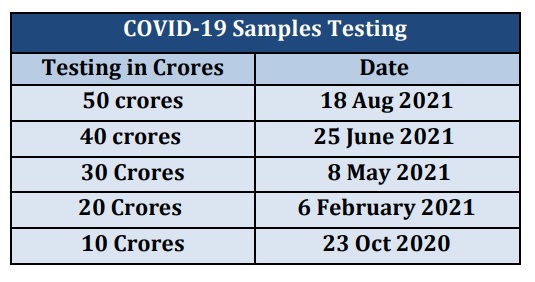
Indian Council of Medical Research [ICMR], the apex body at the forefront of formulating COVID-19 testing strategy in India has achieved the milestone of conducting 40 crores testing on 25th June, 2021. With average testing of more than 18 lakhs per day in the month of June, India has tested 40,18,11,892 samples across the country till 25th June 21 [Friday].
As on 1st June 2021, India had tested 35 Crores COVID-19 samples, it reached 40 crores mark on 25th June, 2021. This has been enabled by rapidly increasing testing infrastructure and capacity across the country. ICMR has been enhancing COVID-19 testing capability across the country by expanding and diversifying testing capacity by leveraging technology and facilitating innovation in affordable diagnostic kits.
Prof (Dr.) Balram Bhargava, Director General, ICMR said, “We have effectively responded to the evolving epidemic through focused and collaborative efforts of the Centre, State/UTs government. Exponential increase in testing has led to early identification, prompt isolation & effective treatment of COVID-19 cases. These have eventually resulted in a sustained low fatality rate. This testing milestone are testimony to the fact that India has been successful in implementing strategy of 5T approach “Test, Track, Trace, Treat and use of Technology” efficiently, which will enable us to contain the spread of the pandemic.’’
ICMR’s concentrated efforts towards augmenting and diversifying testing prepared the infrastructure which made it possible to deliver on India’s increased testing requirements in the wake of the second wave of coronavirus. Focus on reducing turnaround time made it possible to conduct record sample testing. ICMR has been enhancing COVID-19 testing capability across the country by leveraging technology and facilitating innovation in affordable diagnostic kits. Through our ardent efforts, it was ensured that a specific testing platform are made available addressing general testing (RT-PCR), High-throughput testing (COBAS), testing at remotest places and PHCs (TrueNAT, CBNAAT), in containment areas (rapid antigen testing) and for large number & migrant population testing (pooled sample testing). The total number of diagnostic laboratories has reached 2675. Of which dedicated government laboratories are 1676 and private laboratories number stands at 999. ICMR has also approved India’s first self-use Rapid Antigen Test (RAT) for COVID-19 and is encouraging self-test kits to reduce queues in laboratories, reduce costs, dissipate the burden on existingmanpower for sample collectionfrom homes, and provide results without delay.
The Indian Council of Medical Research (ICMR), New Delhi, the apex body in India for the formulation, coordination and promotion of biomedical research, is one of the oldest medical research bodies in the world. The ICMR has always attempted to address itself to the growing demands of scientific advances in biomedical research on the one hand, and to the need of finding practical solutions to the health problems of the country, on the other. The ICMR has come a long way from the days when it was known as the IRFA, but the Council is conscious of the fact that it still has miles to go in pursuit of scientific achievements as well as health targets. The Council's research priorities coincide with the National health priorities such as control and management of communicable diseases, fertility control, maternal and child health, control of nutritional disorders, developing alternative strategies for health care delivery, containment within safety limits of environmental and occupational health problems; research on major non-communicable diseases like cancer, cardiovascular diseases, blindness, diabetes and other metabolic and haematological disorders; mental health research and drug research (including traditional remedies). All these efforts are undertaken with a view to reduce the total burden of disease and to promote health and well-being of the population. For more information, please visit https://www.icmr.gov.in/
The contribution of non-communicable and injury-related neurological disorders to the total disease burden more than doubled in India from 1990 to 2019, whereas the contribution of communicable neurological disorders reduced during this period by three-quarters.
The burden of non-communicable neurological disorders is increasing in India mainly due to ageing of the population.
While communicable diseases contributed to the majority of total neurological disorders burden in children younger than 5 years, non-communicable neurological disorders were the highest contributor in all other age groups.
Stroke, headache disorders, and epilepsy are the leading contributors to neurological disorders burden in India. The contribution of all neurological disorders to disease burden in India is shown in the table on page 8 of this press release.
Stroke caused 699,000 deaths in India in 2019, which was 7.4% of the total deaths in the country.
The burden of many neurological disorders varied considerably between the states, which has significant implications for the policies and programmes to reduce this burden.
Among the known risk factors for neurological disorders burden, high blood pressure, air pollution, dietary risks, high fasting plasma glucose, and high body-mass index are the leading contributors.
New Delhi, 14 July 2021 – The first comprehensive estimates of disease burden due to neurological disorders and their trends in every state of India from 1990 published in The Lancet Global Health by the India State-Level Disease Burden Initiative. These neurological disorders include noncommunicable neurological disorders (stroke, headache disorders, epilepsy, cerebral palsy, Alzheimer’s disease and other dementias, brain and central nervous system cancer, Parkinson’s disease, multiple sclerosis, motor neuron diseases, and other neurological disorders), communicable neurological disorders (encephalitis, meningitis, and tetanus), and injury-related neurological disorders (traumatic brain injuries and spinal cord injuries). The findings in this paper highlight that the contribution of non-communicable neurological disorders and neurological injuries to the total disease burden has more than doubled between 1990 and 2019. The burden of many neurological disorders vary substantially across the states of India.
The state-specific findings described in this scientific paper highlight the extent of the effort needed in each state to reduce the burden of neurological disorders through state-specific health system responses aimed at increasing awareness, early identification, cost-effective treatment, and rehabilitation. The trends over about three decades reported in this research paper utilized all available data sources from India, which enabled more robust estimates of neurological disorder burden across India than those available so far.
Prof Vinod Paul, Hon’ble Member NITI Aayog said on the release of the findings, “This scientific paper presents a comprehensive perspective of the burden of neurological disorders over the last thirty years, and systematically highlights the variations between the states. Several government policies and initiatives are in place to address the burden of neurological disorders across India, however more focused efforts are required for the planning of specific neurology services in each state. There is a need to address the shortage of trained neurology workforce, and strengthen early detection and cost-effective management of neurological disorders in the country to deal with their growing burden.”
Prof Balram Bhargava, Secretary to the Government of India, Department of Health Research, Ministry of Health & Family Welfare, and Director General, ICMR said “This research paper provides the first consolidated estimates on the burden of most neurological disorders for every state of India from 1990 to 2019. Neurological disorders contribute 10% of the total disease burden in India. There is a growing burden of non-communicable neurological disorders in the country, which is mainly attributable to ageing of the population. The findings presented in this research paper are useful for health-care planning at the state level to reduce the neurological disorders burden.”
Prof Gagandeep Singh, Professor, Dayanand Medical College, and the first author of the paper said, “The analysis in this paper highlights key issues related to trends of neurological disorders in the states of India. Epilepsy is a common neurological disorder in India. While the prevalence of epilepsy has increased over the past three decades, it is gratifying to note that India has made some gains in reducing premature deaths and morbidity of people with epilepsy over this period by reducing treatment gaps. There is however a need to scale up treatment coverage of epilepsy in governmental schemes such as the Rashtriya Bal Swasthya Karyakram and Ayushman Bharat. Policies and practices focusing on safe births, preventing head injury and stroke would help in averting a substantial proportion of epilepsies.”
Prof Lalit Dandona, Director of the India State-Level Disease Burden Initiative, who is Honorary Distinguished Scientist at ICMR, Distinguished Professor at PHFI, and senior author of this paper said, “This study based on collaboration with leading neurology experts in India provides policy-relevant insights into the trends of neurological disorders across the states. While the burden of infectious neurological disorders has fallen in India, this burden is higher in less developed states. On the other hand, the burden of neurological disorders related to injury is higher in more developed states. Among non-communicable neurological disorders, stroke is the third leading cause of death in India, and dementias are the fastest growing neurological disorder. These and other findings in the paper have important implications for planning to reduce the growing burden of neurological disorders in India.” Prof N Girish Rao, Professor, National Institute of Mental Health and Neuro Sciences, and a co-author on this paper said, “Headache is the commonest neurological disorder affecting 1 in 3 Indians, and is often neglected in terms of public health priority. It is the second leading contributor to the disease burden from neurological disorders in India. Migraine affects females more than males, greatly affecting adults in the working age population. Headaches, especially migraine, need to be recognised as a public health problem and included under the national NCD programme. The time is right for ushering structured headache services in India and develop standards of quality of care, else the missed opportunity is huge.”
Prof K Srinath Reddy, President, Public Health Foundation of India said, “The rise of noncommunicable disease related risk factors, as leading contributors to neurological disorders and resultant disability in India, is not a surprise. It reflects the demographic, socio-economic and nutrition transitions that have steered the shift in our epidemiological profile over the past 30 years. What is helpful is the recognition that much of this burden of disease and disability is related to modifiable risk factors which can be reduced at the population level and corrected at the individual level. We need policy, health system and personal level actions to achieve healthy ageing across a long life course.”
Prof Christopher Murray, Director of the Institute for Health Metrics and Evaluation at the University of Washington’s School of Medicine said “These results show us the importance of looking at the subnational level and at different age groups to truly understand disease burden within a country.
While non-communicable diseases were the largest contributor to health loss from neurological disorders for most age groups, communicable diseases were the largest contributor for children under 5 years of age. The pattern also varies considerably between the states. The data make a strong argument for the importance of locally-tailored health policies to address gaps and strengthen health system neurology services.”
The findings reported in the paper published today are part of the Global Burden of Disease Study 2019. The analytical methods of this study have been refined over a quarter century of scientific work, which has been reported in more than 16,000 peer-reviewed publications, making it the most widely used approach globally for disease burden estimation. These methods enable standardized comparisons of health loss caused by different diseases and risk factors, between different geographies, sexes, and age groups, and over time in a unified framework.
(PHFI) is a premier public health institution in India with presence across the country. It collaborates with multiple constituencies including Indian and international academia, state and central governments, multi- and bi-lateral agencies, and civil society groups. The vision of PHFI is to strengthen India’s public health institutional and systems capability and provide knowledge to achieve better health outcomes for all through strengthening training, research and policy development in public health. As part of this vision, PHFI has major interest in improving the robustness of sub-national disease burden estimates to inform health action and in evaluating the impact of large-scale population health interventions. www.phfi.org
n (IHME) is a global research institute at the University of Washington in Seattle that provides independent, rigorous, and comparable measurement of the world’s most important health problems and evaluates the strategies used to address them. IHME aims to identify the best strategies to build a healthier world by measuring health, tracking program performance, finding ways to maximize health system impact and developing innovative measurement systems to provide a foundation for informed decision-making that will ultimately allocate resources to best improve population health. www.healthdata.org
The Indian Council of Medical Research (ICMR), New Delhi, the apex body in India for the formulation, coordination and promotion of biomedical research, is one of the oldest medical research bodies in the world. The ICMR has always attempted to address itself to the growing demands of scientific advances in biomedical research on the one hand, and to the need of finding practical solutions to the health problems of the country, on the other. The ICMR has come a long way from the days when it was known as the IRFA, but the Council is conscious of the fact that it still has miles to go in pursuit of scientific achievements as well as health targets. The Council's research priorities coincide with the National health priorities such as control and management of communicable diseases, fertility control, maternal and child health, control of nutritional disorders, developing alternative strategies for health care delivery, containment within safety limits of environmental and occupational health problems; research on major non-communicable diseases like cancer, cardiovascular diseases, blindness, diabetes and other metabolic and haematological disorders; mental health research and drug research (including traditional remedies). All these efforts are undertaken with a view to reduce the total burden of disease and to promote health and well-being of the population. For more information, please visit https://www.icmr.gov.in/