
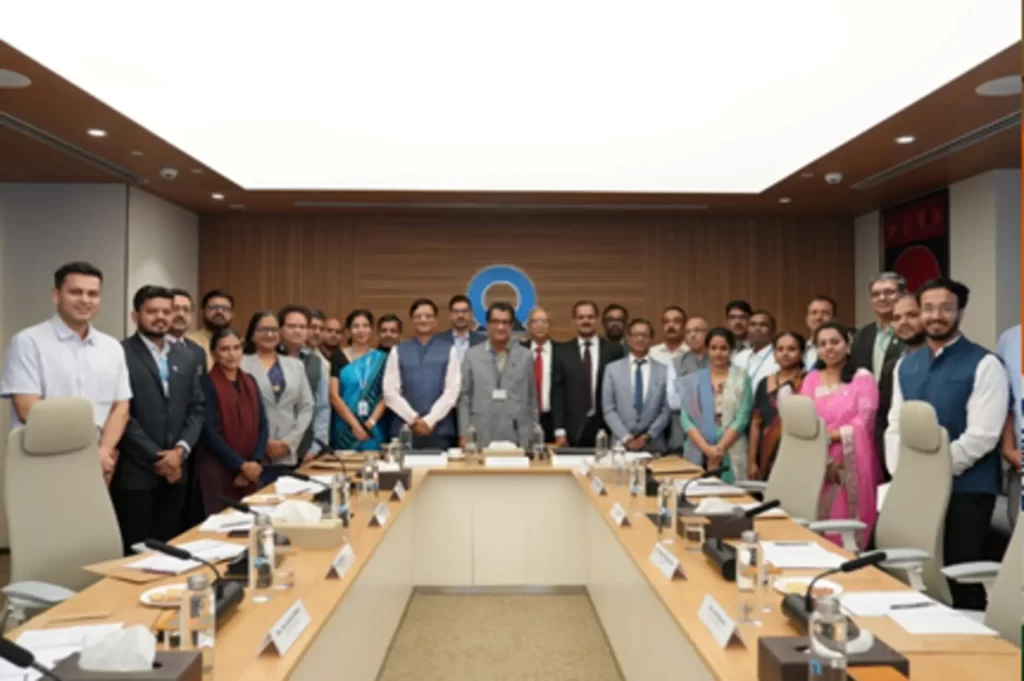
At the invitation of India’s Minister for Commerce and Industry Shri Piyush Goyal, the Honourable Maninder Sidhu, Canada’s Minister of Export Promotion, International Trade and Economic Development, undertook an official visit to India from 11 to 14 November 2025.
Pursuant to the direction provided by the Prime Ministers of the two countries during their bilateral meeting on the sidelines of the G7 meeting in Kananaskis, Canada, as well as the Foreign Ministers Joint Statement: “Renewing momentum towards a stronger partnership” of 13th October 2025 which identified trade as the cornerstone of bilateral economic growth and resilience, the two Trade Ministers held the 7th edition of the Ministerial Dialogue on Trade and Investment (MDTI).
The Ministers reaffirmed the strength and continuity of the India–Canada economic partnership and reiterated their commitment to deepening bilateral cooperation through sustained dialogue, mutual respect, and forward-looking initiatives.
The Ministers noted robust growth in bilateral trade in goods and services which reached US$23.66 billion in 2024, with merchandise trade valued at nearly US$8.98 billion, a substantial 10% increase over the previous year. The Ministers reaffirmed the strength and resilience of the India–Canada economic partnership and emphasized the importance of continued engagement with the private sector to unlock new opportunities for trade and investment. They welcomed the steady expansion of two-way investment flows, including notable Canadian institutional investment in India and the growing presence of Indian firms in Canada, which together support tens of thousands of jobs in both economies. The Ministers committed to maintaining an open, transparent, and predictable investment environment and to exploring avenues for deeper collaboration across priority and emerging sectors.
The Ministers also noted strong complementarities between India and Canada across strategic sectors driving sustainable growth and innovation and offering new opportunities for trade. Recognizing that these areas would require separate domain-level engagement between relevant stakeholders on both sides, the Ministers:
• Agreed to encourage long-term supply chain partnerships in critical minerals and clean energy collaboration essential for energy transition, and new-age industrial expansion.
• Agreed to identify and expand investment and trading opportunities in aerospace and dual-use capabilities partnerships, leveraging Canada’s established presence in India and the growth of India’s aviation sector.
Recognizing the importance of supply chain resilience the Ministers exchanged views on global developments and reflected on lessons from recent disruptions. They underscored the relevance of strengthening resilience in critical sectors, including agriculture, and highlighted the need for diversified and reliable supply chains as essential for supporting long-term economic stability.
The Ministers expressed satisfaction with the progress made in strengthening bilateral economic engagement and reaffirmed their shared commitment to elevate the economic partnership to reflect global developments and evolving supply chain and trade dynamics. They emphasized the importance of maintaining momentum in the bilateral dialogue and supporting people-to-people ties, which provide a strong foundation for the partnership.
The Ministers agreed to sustained ministerial engagements with the trade and investment community in both Canada and India early next year.
They agreed to remain in close communication as they consider next steps and concluded by acknowledging the constructive and forward-looking discussions held in New Delhi.
The annual rate of inflation based on All India Wholesale Price Index (WPI) number is (-) 1.21% (provisional) for the month of October, 2025 (over October, 2024). Negative rate of inflation in October, 2025 is primarily due to decrease in prices of food articles, crude petroleum & natural gas, electricity, mineral oils and manufacture of basic metals etc. The index numbers and inflation rate for the last three months of all commodities and WPI components are given below:
| Index Numbers and Annual Rate of Inflation (Y-o-Y in %) * | |||||||
| All Commodities/Major Groups | Weight (%) | Aug-25(F) | Sep-25(P) | Oct-25(P) | |||
| Index | Inflation | Index | Inflation | Index | Inflation | ||
| All Commodities | 100.00 | 155.2 | 0.52 | 154.9 | 0.13 | 154.8 | -1.21 |
| I. Primary Articles | 22.62 | 191.0 | -2.10 | 189.0 | -3.32 | 188.2 | -6.18 |
| II. Fuel & Power | 13.15 | 143.5 | -3.24 | 143.4 | -2.58 | 145.0 | -2.55 |
| III. Manufactured Products | 64.23 | 145.0 | 2.62 | 145.2 | 2.33 | 145.1 | 1.54 |
| Food Index | 24.38 | 193.5 | 0.21 | 192.0 | -1.99 | 192.0 | -5.04 |
Note: F: Final, P: Provisional, *Annual rate of WPI inflation calculated over the corresponding month of previous year
The month over month change in WPI for the month of October, 2025 stood at (-) 0.06% as compared to September, 2025. The monthly change in WPI for last six-month is summarized below:
| Month Over Month (M-o-M in %) change in WPI Index# | |||||||
| All Commodities/Major Groups | Weight | May-25 | Jun-25 | Jul-25 | Aug-25(F) | Sep-25(P) | Oct-25(P) |
| All Commodities | 100.00 | -0.32 | 0.00 | 0.46 | 0.52 | -0.19 | -0.06 |
| I. Primary Articles | 22.62 | -0.32 | 0.70 | 1.29 | 1.33 | -1.05 | -0.42 |
| II. Fuel & Power | 13.15 | -1.92 | -0.42 | 0.98 | -0.14 | -0.07 | 1.12 |
| III. Manufactured Products | 64.23 | 0.07 | -0.21 | -0.07 | 0.28 | 0.14 | -0.07 |
| Food Index | 24.38 | -0.42 | 0.16 | 0.63 | 1.10 | -0.78 | 0.00 |
Note: F: Final, P: Provisional, #Monthly rate of change, based on month over month (M-o-M) WPI calculated over the preceding month
Month-over-Month Change in Major Groups of WPI:
WPI Food Index (Weight 24.38%): The Food Index consisting of 'Food Articles' from Primary Articles group and 'Food Product' from Manufactured Products group has remain constant 192.0 from September, 2025 to October, 2025. The rate of inflation (Y-o-Y) based on WPI Food Index decreased to (-) 5.04% in October, 2025 from (-) 1.99% in September, 2025.
Final Index for the month of August, 2025 (Base Year: 2011-12=100): For the month of August, 2025, the final Wholesale Price Index and inflation rate for 'All Commodities' (Base: 2011-12=100) stood at 155.2 and 0.52% respectively.
The details of all India Wholesale Price Indices and Rates of Inflation for different commodity groups based on updated figures are at Annex I. The Annual rate of Inflation (Y-o-Y) based on WPI for different commodity groups in the last six months is at Annex II. WPI for different commodity groups in the last six months is at Annex III.
Response Rate: The WPI for October, 2025 has been compiled at a weighted response rate of 84.2 per cent, while the final figure for August, 2025 is based on the weighted response rate of 94.2 per cent. The provisional figures of WPI will undergo revision as per the revision policy of WPI. This press release, item indices, and inflation numbers are available at our website https://eaindustry.nic.in.
Next date of Press Release: WPI for the month of November, 2025 would be released on 15/12/2025.
Note: DPIIT releases index number of wholesale price in India on monthly basis on 14th of every month (or next working day, if 14th falls on holiday) with a time lag of two weeks of the reference month, and the index number is compiled with data received from institutional sources and selected manufacturing units across the country. This press release contains WPI (Base Year 2011-12=100) for the month of October, 2025 (Provisional), August, 2025 (Final) and other months/years. Provisional figures of WPI are finalised after 10 weeks (from the month of reference), and frozen thereafter.
Annex-I
All India Wholesale Price Indices and Rates of Inflation (Base Year: 2011-12=100) for October, 2025
| Commodities/Major Groups/Groups/Sub-Groups/Items | Weight | IndexOct-25* | Latest month over Month (MoM) | Inflation (YoY) | Rate of Inflation (YoY) | |||
| Sep-Oct 2024 | Sep-Oct2025* | 2024-25 (Apr-Oct) | 2025-26 (Apr-Oct) | October 2024 | October2025* | |||
| ALL COMMODITIES | 100.00 | 154.8 | 1.29 | -0.06 | 2.19 | -0.06 | 2.75 | -1.21 |
| I. PRIMARY ARTICLES | 22.62 | 188.2 | 2.61 | -0.42 | 5.98 | -3.21 | 8.26 | -6.18 |
| A. Food Articles | 15.26 | 199.8 | 3.37 | 0.00 | 8.54 | -4.02 | 13.49 | -8.31 |
| Cereals | 2.82 | 206.4 | 0.87 | 0.15 | 8.69 | 1.25 | 7.80 | -1.05 |
| Paddy | 1.43 | 201.4 | 0.49 | 0.55 | 10.29 | -0.08 | 7.47 | -1.47 |
| Wheat | 1.03 | 211.3 | 2.04 | -0.09 | 6.92 | 4.23 | 8.04 | 0.81 |
| Pulses | 0.64 | 195.8 | -1.22 | -0.41 | 17.08 | -13.57 | 9.27 | -16.50 |
| Vegetables | 1.87 | 234.7 | 16.08 | -0.13 | 20.82 | -24.17 | 62.86 | -34.97 |
| Potato | 0.28 | 225.8 | -0.16 | 3.91 | 74.34 | -37.10 | 79.11 | -39.88 |
| Onion | 0.16 | 165.3 | -3.06 | -7.45 | 67.16 | -45.91 | 39.25 | -65.43 |
| Fruits | 1.60 | 195.7 | 0.57 | -2.54 | 10.24 | 1.49 | 13.60 | -7.03 |
| Milk | 4.44 | 191.2 | 0.16 | 0.21 | 3.81 | 2.55 | 3.00 | 3.02 |
| Eggs, Meat & Fish | 2.40 | 174.0 | -0.93 | -0.46 | -0.77 | 0.05 | -0.52 | 1.75 |
| B. Non-Food Articles | 4.12 | 164.4 | -0.18 | -1.73 | -2.31 | 2.70 | -1.34 | 1.54 |
| Oil Seeds | 1.12 | 196.8 | 0.43 | -2.62 | -3.22 | 7.13 | 1.98 | 6.15 |
| C. Minerals | 0.83 | 242.4 | 2.87 | 1.72 | 5.26 | 3.31 | 4.51 | 5.57 |
| D. Crude Petroleum & Natural gas | 2.41 | 136.2 | 0.82 | -3.13 | 1.25 | -10.06 | -11.80 | -7.54 |
| Crude Petroleum | 1.95 | 109.0 | 2.11 | -4.64 | 0.61 | -13.80 | -12.49 | -13.56 |
| II. FUEL & POWER | 13.15 | 145.0 | 1.09 | 1.12 | -0.92 | -3.30 | -4.31 | -2.55 |
| LPG | 0.64 | 108.4 | 2.57 | 0.84 | 3.72 | -2.17 | 2.57 | -9.52 |
| Petrol | 1.60 | 146.0 | -1.19 | 0.07 | -3.02 | -5.98 | -7.35 | -2.60 |
| HSD | 3.10 | 161.1 | -0.55 | 0.69 | -3.01 | -4.18 | -6.23 | -1.89 |
| III. MANUFACTURED PRODUCTS | 64.23 | 145.1 | 0.70 | -0.07 | 1.11 | 2.17 | 1.78 | 1.54 |
| Mf/o Food Products | 9.12 | 179.0 | 2.87 | 0.11 | 4.80 | 6.41 | 9.39 | 1.76 |
| Vegetable & Animal Oils and Fats | 2.64 | 186.8 | 9.46 | 0.21 | 5.36 | 19.61 | 26.03 | 4.83 |
| Mf/o Beverages | 0.91 | 135.9 | 0.15 | 0.15 | 2.01 | 1.37 | 2.13 | 1.04 |
| Mf/o Tobacco Products | 0.51 | 181.6 | -0.85 | 0.28 | 2.02 | 2.79 | 1.09 | 3.18 |
| Mf/o Textiles | 4.88 | 138.5 | 0.07 | 0.29 | 0.77 | 0.89 | 0.89 | 1.91 |
| Mf/o Wearing Apparel | 0.81 | 156.5 | 0.20 | 0.19 | 1.65 | 1.79 | 1.25 | 1.69 |
| Mf/o Leather and Related Products | 0.54 | 127.3 | 0.56 | 0.00 | 0.17 | 2.47 | 1.37 | 1.27 |
| Mf/o Wood and Products of Wood and Cork | 0.77 | 151.1 | 0.07 | 0.73 | 2.71 | 0.65 | 1.09 | 1.61 |
| Mf/o Paper and Paper Products | 1.11 | 140.3 | 0.00 | 0.00 | -2.01 | 0.91 | 0.94 | 0.36 |
| Mf/o Chemicals and Chemical Products | 6.47 | 136.8 | -0.15 | -0.22 | -1.07 | 0.63 | -0.22 | 0.37 |
| Mf/o Pharmaceuticals, Medicinal Chemical and Botanical Products | 1.99 | 146.2 | -0.42 | 0.27 | 1.03 | 1.20 | 0.42 | 1.88 |
| Mf/o Rubber and Plastics Products | 2.30 | 128.9 | 0.70 | -0.08 | 1.04 | 0.41 | 1.89 | -0.54 |
| Mf/o other Non-Metallic Mineral Products | 3.20 | 133.0 | -0.15 | -0.67 | -3.01 | 1.83 | -3.83 | 1.99 |
| Cement, Lime and Plaster | 1.64 | 132.0 | -0.08 | -1.27 | -5.52 | 1.92 | -7.20 | 2.48 |
| Mf/o Basic Metals | 9.65 | 137.1 | 1.16 | -0.22 | -1.07 | -1.76 | -2.04 | -1.58 |
| Mild Steel - Semi Finished Steel | 1.27 | 114.6 | 3.42 | -0.69 | -2.85 | -1.33 | -1.67 | -2.88 |
| Mf/o Fabricated Metal Products, Except Machinery and Equipment | 3.15 | 137.0 | -0.95 | 0.07 | -2.19 | 0.65 | -2.81 | 1.48 |
Note: * = Provisional. Mf/o = Manufacture of
Annex-II
WPI Inflation (Base Year: 2011-12=100) for last 6 months
| Commodities/Major Groups/Groups/Sub-Groups/Items | Weight | WPI based inflation (YoY) figures for last 6 months | |||||
| May-25 | Jun-25 | Jul-25 | Aug-25 | Sep-25* | Oct-25* | ||
| ALL COMMODITIES | 100.00 | 0.13 | -0.19 | -0.58 | 0.52 | 0.13 | -1.21 |
| I. PRIMARY ARTICLES | 22.62 | -1.75 | -3.22 | -4.70 | -2.10 | -3.32 | -6.18 |
| A. Food Articles | 15.26 | -1.25 | -3.65 | -6.29 | -3.11 | -5.22 | -8.31 |
| Cereals | 2.82 | 2.56 | 1.44 | 1.43 | 1.03 | -0.34 | -1.05 |
| Paddy | 1.43 | 0.96 | 0.25 | 0.15 | -0.84 | -1.52 | -1.47 |
| Wheat | 1.03 | 5.75 | 3.77 | 4.40 | 4.75 | 2.97 | 0.81 |
| Pulses | 0.64 | -10.41 | -14.09 | -15.21 | -15.23 | -17.19 | -16.50 |
| Vegetables | 1.87 | -21.40 | -22.65 | -29.02 | -14.34 | -24.41 | -34.97 |
| Potato | 0.28 | -28.97 | -32.50 | -41.54 | -44.56 | -42.24 | -39.88 |
| Onion | 0.16 | -14.17 | -33.45 | -44.38 | -50.46 | -63.79 | -65.43 |
| Fruits | 1.60 | 11.01 | 1.69 | -2.65 | -4.86 | -4.06 | -7.03 |
| Milk | 4.44 | 3.32 | 2.53 | 2.37 | 2.58 | 2.97 | 3.02 |
| Eggs, Meat & Fish | 2.40 | -1.01 | -0.29 | -1.09 | 0.06 | 1.27 | 1.75 |
| B. Non-Food Articles | 4.12 | 1.28 | 2.16 | 3.65 | 5.56 | 3.14 | 1.54 |
| Oil Seeds | 1.12 | 2.68 | 5.89 | 9.77 | 14.00 | 9.48 | 6.15 |
| C. Minerals | 0.83 | 0.57 | -0.35 | 4.19 | 4.70 | 6.77 | 5.57 |
| D. Crude Petroleum & Natural gas | 2.41 | -11.54 | -10.77 | -10.58 | -9.87 | -3.76 | -7.54 |
| Crude Petroleum | 1.95 | -13.97 | -12.31 | -14.86 | -13.68 | -7.45 | -13.56 |
| II. FUEL & POWER | 13.15 | -4.80 | -3.13 | -3.04 | -3.24 | -2.58 | -2.55 |
| LPG | 0.64 | 0.25 | 2.68 | 1.23 | -1.22 | -7.96 | -9.52 |
| Petrol | 1.60 | -9.44 | -6.57 | -5.74 | -5.72 | -3.82 | -2.60 |
| HSD | 3.10 | -6.20 | -5.12 | -4.30 | -3.54 | -3.09 | -1.89 |
| III. MANUFACTURED PRODUCTS | 64.23 | 2.11 | 1.90 | 2.05 | 2.62 | 2.33 | 1.54 |
| Mf/o Food Products | 9.12 | 8.45 | 6.87 | 6.86 | 7.27 | 4.56 | 1.76 |
| Vegetable & Animal Oils and Fats | 2.64 | 25.81 | 22.30 | 22.04 | 23.06 | 14.50 | 4.83 |
| Mf/o Beverages | 0.91 | 1.65 | 1.50 | 1.20 | 1.19 | 1.04 | 1.04 |
| Mf/o Tobacco Products | 0.51 | 4.30 | 2.04 | 1.81 | 3.24 | 2.03 | 3.18 |
| Mf/o Textiles | 4.88 | 0.44 | 0.00 | 0.00 | 1.32 | 1.69 | 1.91 |
| Mf/o Wearing Apparel | 0.81 | 2.11 | 2.10 | 2.30 | 1.90 | 1.69 | 1.69 |
| Mf/o Leather and Related Products | 0.54 | 2.90 | 2.33 | 2.89 | 2.32 | 1.84 | 1.27 |
| Mf/o Wood and Products of Wood and Cork | 0.77 | 0.47 | 0.60 | 0.13 | 0.00 | 0.94 | 1.61 |
| Mf/o Paper and Paper Products | 1.11 | 1.45 | 1.16 | 1.01 | 0.07 | 0.36 | 0.36 |
| Mf/o Chemicals and Chemical Products | 6.47 | 1.03 | 0.51 | 0.29 | 0.37 | 0.44 | 0.37 |
| Mf/o Pharmaceuticals, Medicinal Chemical and Botanical Products | 1.99 | 1.32 | 1.18 | 0.90 | 0.55 | 1.18 | 1.88 |
| Mf/o Rubber and Plastics Products | 2.30 | 0.78 | 0.54 | 0.08 | 0.08 | 0.23 | -0.54 |
| Mf/o other Non-Metallic Mineral Products | 3.20 | 0.98 | 2.07 | 2.62 | 3.08 | 2.53 | 1.99 |
| Cement, Lime and Plaster | 1.64 | 0.15 | 1.92 | 3.19 | 4.54 | 3.72 | 2.48 |
| Mf/o Basic Metals | 9.65 | -3.11 | -3.28 | -2.56 | -0.51 | -0.22 | -1.58 |
| Mild Steel - Semi Finished Steel | 1.27 | -2.87 | -3.78 | -2.36 | 1.31 | 1.14 | -2.88 |
| Mf/o Fabricated Metal Products, Except Machinery and Equipment | 3.15 | 0.95 | 0.66 | 0.15 | 0.29 | 0.44 | 1.48 |
Note: * = Provisional. Mf/o = Manufacture of
Annex-III
Wholesale Price Indices (Base Year: 2011-12=100) for last 6 months
| Commodities/Major Groups/Groups/Sub-Groups/Items | Weight | WPI Numbers for last 6 months | |||||
| May-25 | Jun-25 | Jul-25 | Aug-25 | Sep-25* | Oct-25* | ||
| ALL COMMODITIES | 100.00 | 153.7 | 153.7 | 154.4 | 155.2 | 154.9 | 154.8 |
| I. PRIMARY ARTICLES | 22.62 | 184.8 | 186.1 | 188.5 | 191.0 | 189.0 | 188.2 |
| A. Food Articles | 15.26 | 196.8 | 198.0 | 199.7 | 202.5 | 199.8 | 199.8 |
| Cereals | 2.82 | 204.7 | 204.4 | 205.9 | 206.7 | 206.1 | 206.4 |
| Paddy | 1.43 | 199.6 | 199.9 | 201.4 | 200.3 | 200.3 | 201.4 |
| Wheat | 1.03 | 207.8 | 206.5 | 209.0 | 211.8 | 211.5 | 211.3 |
| Pulses | 0.64 | 200.6 | 197.0 | 195.7 | 198.1 | 196.6 | 195.8 |
| Vegetables | 1.87 | 185.8 | 219.2 | 246.3 | 259.8 | 235.0 | 234.7 |
| Potato | 0.28 | 221.4 | 232.0 | 232.5 | 218.2 | 217.3 | 225.8 |
| Onion | 0.16 | 176.3 | 185.8 | 193.5 | 193.8 | 178.6 | 165.3 |
| Fruits | 1.60 | 224.8 | 204.3 | 191.0 | 197.6 | 200.8 | 195.7 |
| Milk | 4.44 | 190.1 | 190.2 | 190.4 | 190.7 | 190.8 | 191.2 |
| Eggs, Meat & Fish | 2.40 | 176.6 | 174.0 | 171.8 | 173.2 | 174.8 | 174.0 |
| B. Non-Food Articles | 4.12 | 158.5 | 160.7 | 164.7 | 169.1 | 167.3 | 164.4 |
| Oil Seeds | 1.12 | 184.0 | 190.6 | 197.8 | 203.6 | 202.1 | 196.8 |
| C. Minerals | 0.83 | 228.4 | 228.8 | 236.1 | 238.3 | 238.3 | 242.4 |
| D. Crude Petroleum & Natural gas | 2.41 | 138.8 | 139.2 | 141.2 | 139.7 | 140.6 | 136.2 |
| Crude Petroleum | 1.95 | 113.9 | 116.8 | 116.3 | 113.6 | 114.3 | 109.0 |
| II. FUEL & POWER | 13.15 | 142.9 | 142.3 | 143.7 | 143.5 | 143.4 | 145.0 |
| LPG | 0.64 | 120.3 | 118.8 | 115.2 | 113.0 | 107.5 | 108.4 |
| Petrol | 1.60 | 142.9 | 143.7 | 146.1 | 145.1 | 145.9 | 146.0 |
| HSD | 3.10 | 157.3 | 157.5 | 160.2 | 160.8 | 160.0 | 161.1 |
| III. MANUFACTURED PRODUCTS | 64.23 | 145.0 | 144.7 | 144.6 | 145.0 | 145.2 | 145.1 |
| Mf/o Food Products | 9.12 | 178.4 | 177.3 | 177.5 | 178.6 | 178.8 | 179.0 |
| Vegetable & Animal Oils and Fats | 2.64 | 185.7 | 181.5 | 182.2 | 185.2 | 186.4 | 186.8 |
| Mf/o Beverages | 0.91 | 135.4 | 135.4 | 135.1 | 135.6 | 135.7 | 135.9 |
| Mf/o Tobacco Products | 0.51 | 181.8 | 179.8 | 179.9 | 181.7 | 181.1 | 181.6 |
| Mf/o Textiles | 4.88 | 136.3 | 136.4 | 136.8 | 137.7 | 138.1 | 138.5 |
| Mf/o Wearing Apparel | 0.81 | 155.2 | 155.5 | 155.7 | 155.8 | 156.2 | 156.5 |
| Mf/o Leather and Related Products | 0.54 | 127.6 | 127.5 | 128.0 | 127.8 | 127.3 | 127.3 |
| Mf/o Wood and Products of Wood and Cork | 0.77 | 150.2 | 150.4 | 149.6 | 149.5 | 150.0 | 151.1 |
| Mf/o Paper and Paper Products | 1.11 | 140.1 | 140.0 | 139.9 | 139.9 | 140.3 | 140.3 |
| Mf/o Chemicals and Chemical Products | 6.47 | 137.2 | 137.1 | 137.1 | 137.2 | 137.1 | 136.8 |
| Mf/o Pharmaceuticals, Medicinal Chemical and Botanical Products | 1.99 | 145.9 | 145.7 | 146.0 | 145.6 | 145.8 | 146.2 |
| Mf/o Rubber and Plastics Products | 2.30 | 129.3 | 129.5 | 129.2 | 129.2 | 129.0 | 128.9 |
| Mf/o other Non-Metallic Mineral Products | 3.20 | 133.6 | 133.4 | 133.4 | 133.8 | 133.9 | 133.0 |
| Cement, Lime and Plaster | 1.64 | 133.0 | 132.8 | 132.8 | 133.5 | 133.7 | 132.0 |
| Mf/o Basic Metals | 9.65 | 140.2 | 138.6 | 137.2 | 137.6 | 137.4 | 137.1 |
| Mild Steel - Semi Finished Steel | 1.27 | 118.5 | 117.1 | 115.9 | 115.9 | 115.4 | 114.6 |
| Mf/o Fabricated Metal Products, Except Machinery and Equipment | 3.15 | 137.7 | 137.0 | 136.5 | 137.0 | 136.9 | 137.0 |
Note: * = Provisional. Mf/o = Manufacture of
Union Ministry of Health & Family Welfare, in collaboration with Jhpiego and the World Health Organization (WHO), concluded the three-day National Consultation and Experience Sharing Workshop on Nursing Policy Priorities and Best Practices in India, today in New Delhi.
The workshop brought together senior officials from central and state governments, nursing leaders, academic experts and development partners, and served as a platform to advance the national agenda on nursing and midwifery reforms.
The workshop underscored the importance of systematic workforce planning and management. States and experts recommended the adoption of scientific planning tools to determine appropriate staffing levels, improve deployment, and ensure optimal nurse-to-patient ratios across various levels of care. Deliberations also highlighted the need to create clear and progressive career pathways enabling nurses to take on advanced practice, public health, and leadership roles. Participants agreed that improved workplace conditions, mentorship systems, and supportive supervision would significantly contribute to better retention and professional growth.
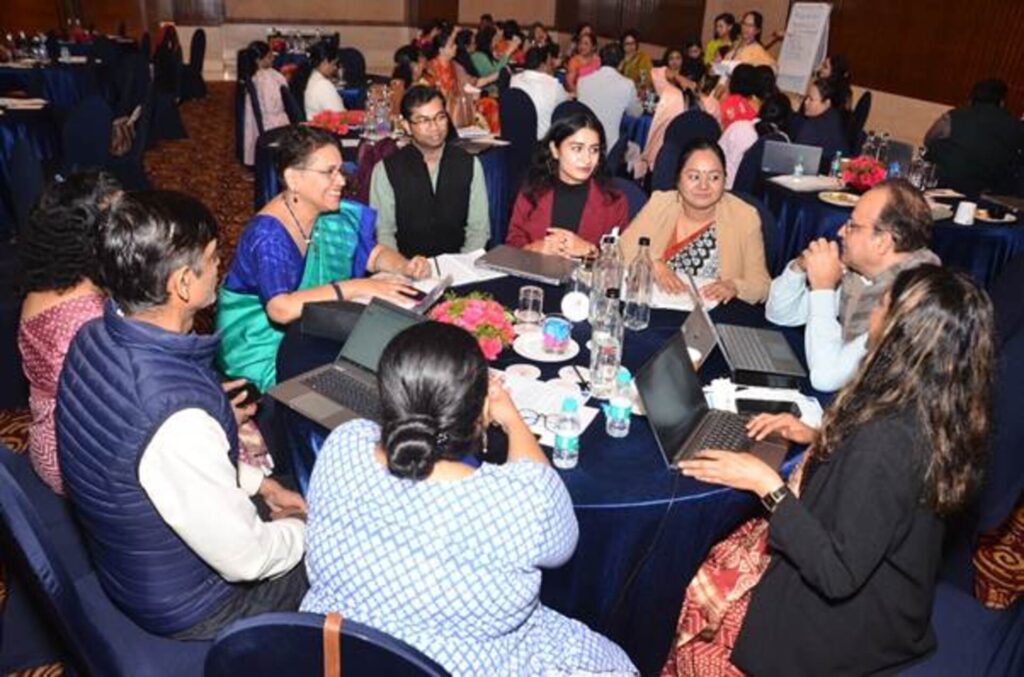
Discussions on service delivery laid strong emphasis on scaling evidence-based nursing practices from across the country. States shared examples of nurse-led care models, quality improvement initiatives, and innovations in community-based service delivery, which can be replicated at national level.
Experts and state representatives shared successful models from across India, including workforce planning innovations, quality improvement frameworks, and capacity-building initiatives. The workshop also reflected on key priorities such as expanding leadership roles for nurses, enhancing workplace environments, and aligning India’s nursing ecosystem with global standards.
Speaking at the valedictory session, Dr. Vinod Kotwal, Additional Secretary, Medical Education, Ministry of Health and Family Welfare, reiterated the sentiments expressed by Union Health Secretary and affirmed that “nurses are the heart of the healthcare delivery system.” She emphasized that the strength, dedication, and clinical competence of India’s nursing workforce form the core of service delivery at every level of care.
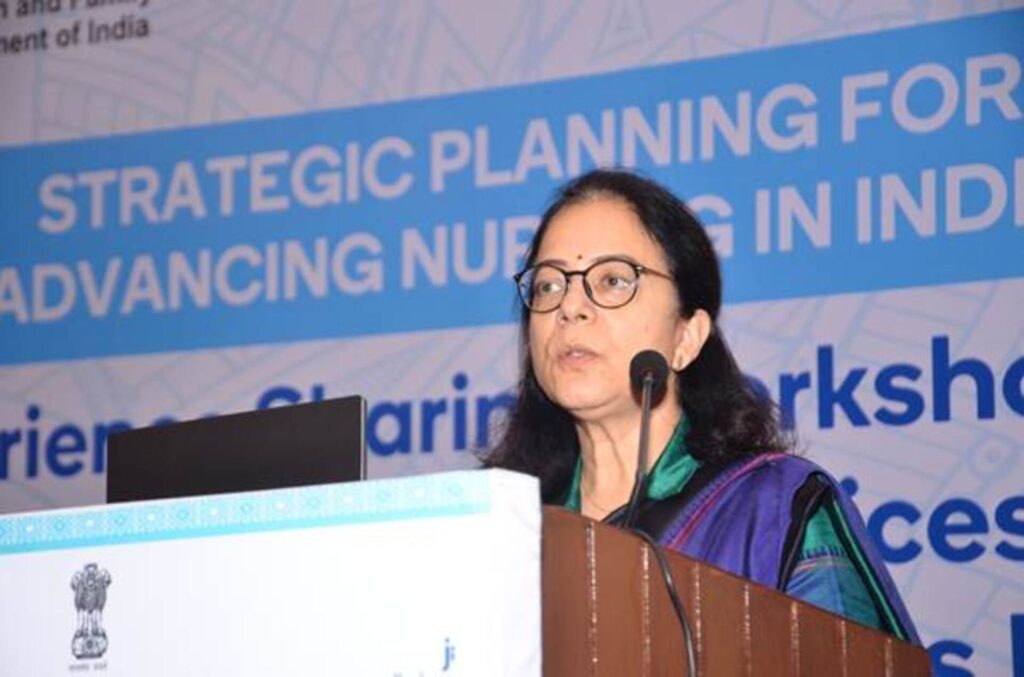
Dr. Kotwal also noted that the recommendations emerging from the workshop hold immense value, as they are rooted in the lived experiences of participants from across states, spanning educators, clinical nurses, administrators, and regulators. She highlighted that one of the most significant aspects of the workshop was the collective sharing of knowledge, with each state presenting its achievements, challenges, and innovations.
She further underscored the importance of developing practical, solution-oriented strategies tailored to India’s resource-constrained settings. She encouraged participants to design interventions that are feasible, sustainable, and aligned with existing capacities, while also pushing for continuous improvement.
Speaking at the occasion, Ms. Akanksha Ranjan, Deputy Secretary, Nursing & Dental, Ministry of Health & Family Welfare, expressed appreciation for the active participation and thoughtful contributions made by nursing leaders, educators, and state representatives throughout the three-day workshop.
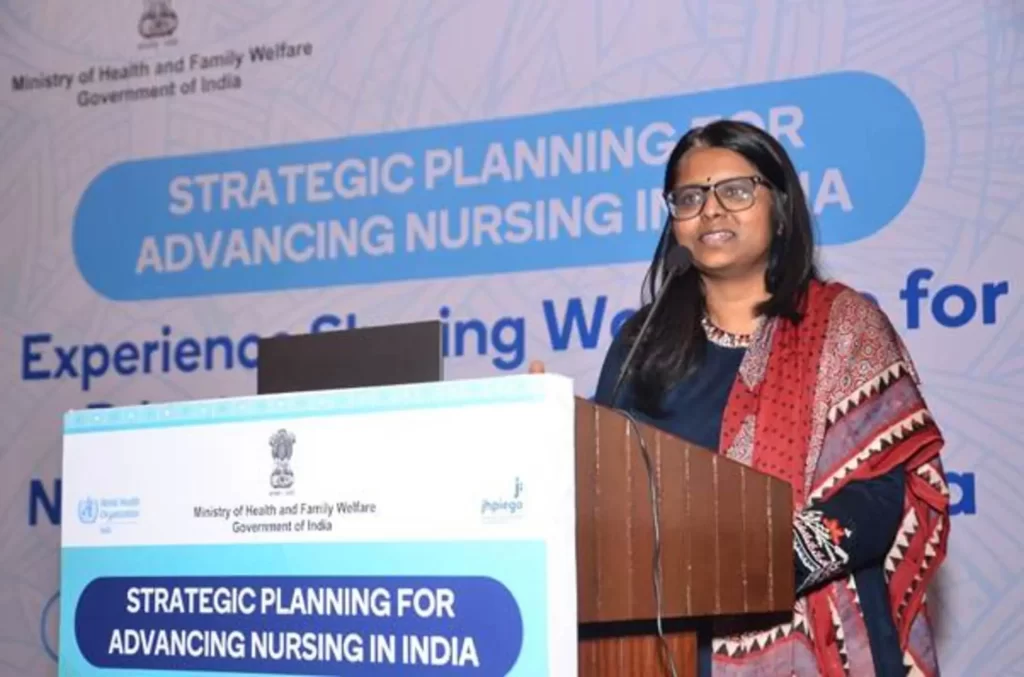
She also stated that the workshop has been highly fruitful in identifying critical gaps in nursing education, service delivery, and governance. She emphasized that the value of this consultation lies not only in recognising these gaps but also in generating practical, solution-oriented approaches. She highlighted that many of the solutions discussed were tailor-made to address the unique challenges of different states, demonstrating the strength of collaborative problem-solving and shared learning.
She underscored the importance of strengthening academic-clinical linkages, enhancing institutional capacities, and ensuring that nursing education remains aligned with the evolving needs of the health system.
Addressing the gathering for way forward, Dr. Deepika C. Khakha, Nursing Advisor, Director General for Health Services (DGHS), Ministry of Health & Family Welfare, commended the commitment demonstrated by nursing professionals and state representatives throughout the workshop. She also stated that, the workshop has effectively set the context for actionable work and tangible reforms in India’s nursing ecosystem. She emphasised that while it is often easy to speak about challenges, true leadership lies in thinking about solutions within the capacities and constraints of the system.
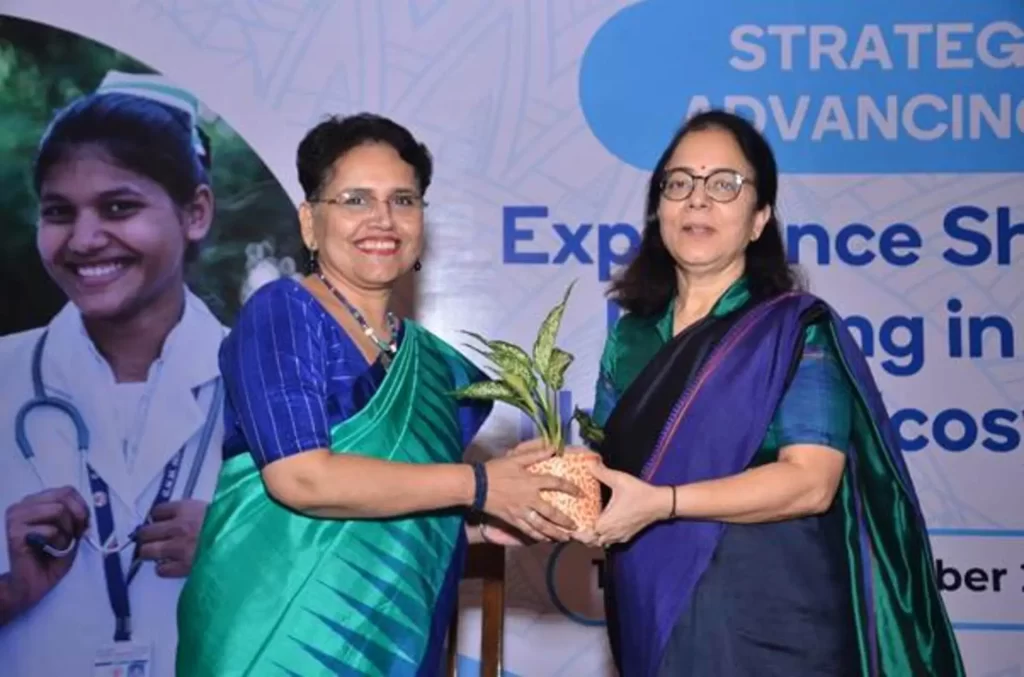
Highlighting that the workshop was “for the nurses, and by the nurses,” she commended the spirit of mutual support and collaborative learning demonstrated by participants. Furthermore, Dr. Khakha underscored the need to strengthen competency-based curriculum, invest in continuous faculty development, and build future-ready nursing leadership. She also noted that India is the second-largest source of migrant nurses globally after the Philippines, which reflects both the high demand for Indian nurses and the need to strengthen governance mechanisms to ensure safe, ethical and well-supported migration pathways.
In her Concluding remarks, she stated that, the way forward must focus on working together as a unified team to strengthen nursing education, regulation and overall governance.
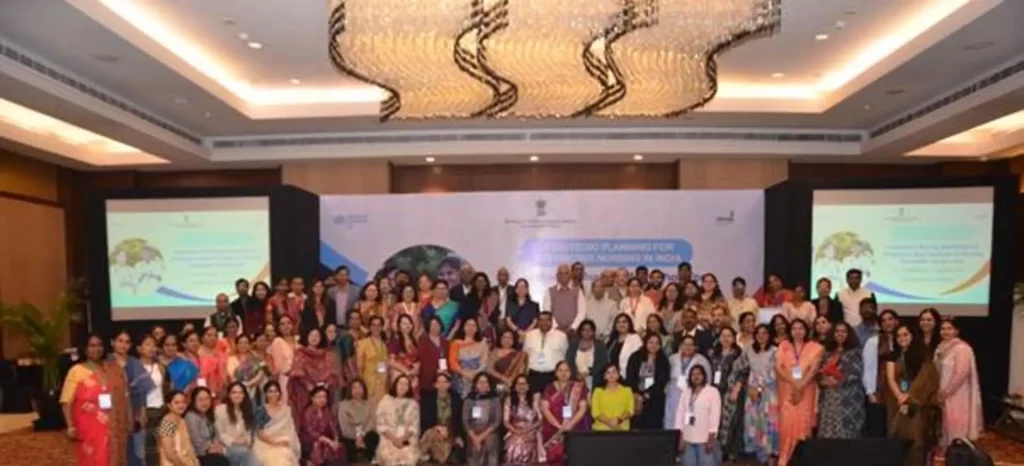
The event concluded with a shared resolve to take forward the recommendations and continue building an empowered, skilled, and motivated nursing workforce that can meet the evolving health needs of the nation. The Ministry reiterated that investing in nursing is vital for achieving quality healthcare and accelerating India’s progress toward Universal Health Coverage.
Dr. Manohar Agnani, Former Additional Secretary, Maternal and Child Health, Ministry of Health and Family welfare, senior state officials and participants from nursing profession were also present at the event.
A delegation of 24 senior government officers from 23 ITEC partner countries visited the head office of the Government e Marketplace (GeM) today as part of a capacity-building initiative under the MoU between GeM and the Arun Jaitley National Institute of Financial Management (AJNIFM).
The visit marked a significant step forward in advancing international collaboration on digital public procurement reforms and reflected the shared vision of GeM and AJNIFM to promote capacity-building, thought leadership, and procurement excellence across borders.
The engagement deepened global understanding of India’s digital procurement transformation and reinforced GeM’s position as a global benchmark for transparent, efficient, and technology-driven public procurement. Delegates engaged extensively with GeM’s core pillars — capacity enhancement, thought leadership, Communities of Practice, and global advocacy — each designed to strengthen procurement access and performance.
“Our aim is to build a procurement ecosystem that is not only efficient, but inclusive. When buyers and sellers connect in a fair, transparent online marketplace, the country benefits,” said Government e Marketplace (GeM), CEO Shri Mihir Kumar.
The programme provided delegates with an in-depth understanding of GeM’s digital architecture, best-in-class procurement practices, and the transformational outcomes achieved across India. It also addressed systemic challenges of traditional procurement and demonstrated how GeM’s technology-led solutions are redefining the public procurement landscape.
Through this visit, GeM reaffirmed its commitment to advancing global advocacy for digital public procurement reform, sharing India’s expertise with partner nations and enabling the adoption of scalable, transparent, and inclusive procurement practices worldwide.
The Graduation and Lamp Lighting Ceremony of Rajkumari Amrit Kaur (RAK) College of Nursing, New Delhi, was held on 12th November 2025 to celebrate the achievements of the M.Sc. Nursing batch 2022–2024 and the B.Sc. Nursing batch 2020–2024.
Smt. Punya Salila Srivastava, Secretary, Ministry of Health and Family Welfare, Government of India, delivered the Keynote address as Chief Guest. The event was also attended Dr. Achala, Additional Director General (Nursing), Directorate General of Health Services (DGHS) and Professor (Dr.) K. Ratnabali, Dean, Academic Affairs, University of Delhi.
Addressing the gathering, Smt. Punya Salila Srivastava, commended the pivotal role of nurses in India’s healthcare delivery system and their contribution to the nation’s progress toward Universal Health Coverage (UHC). She urged the graduating students to uphold the core values of empathy, dedication, and ethical service, emphasizing that nurses form the backbone of the country’s public health response and are central to ensuring quality and accessible healthcare for all.
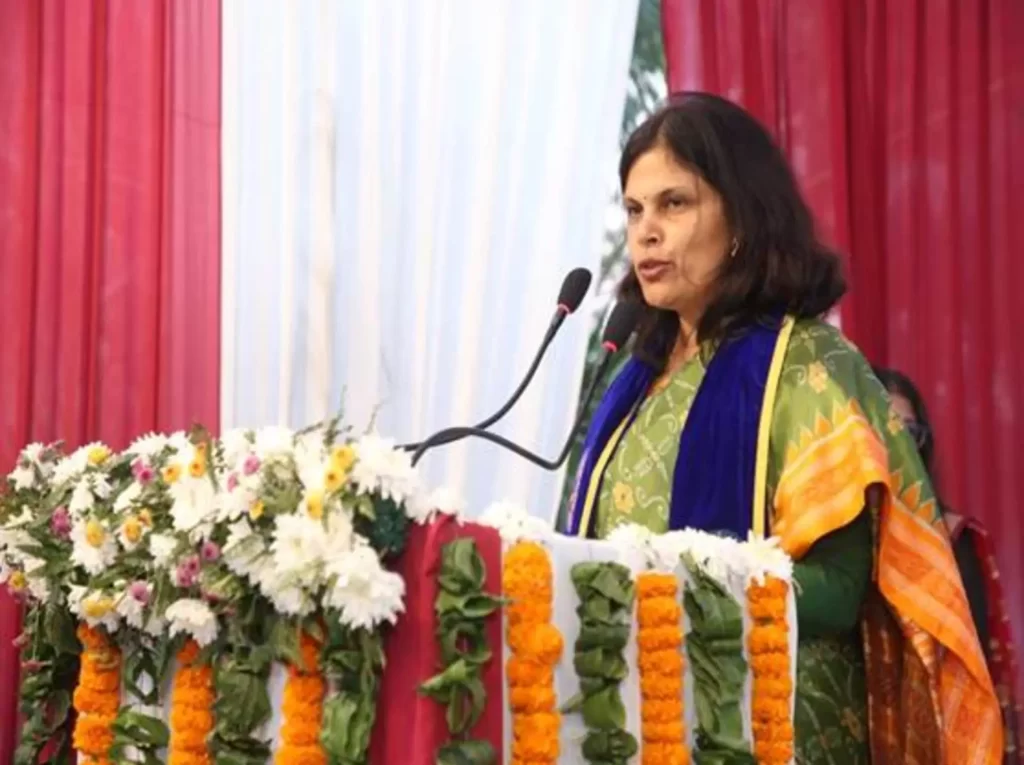
Highlighting the Ministry’s continued commitment to strengthening the nursing and midwifery workforce, the Health Secretary noted that the Government of India, through various initiatives, is focused on expanding training capacity, improving educational standards, and creating an enabling environment for nursing professionals to excel in leadership, research, and clinical roles.
Addressing the gathering, Dr. Achala, ADG (Nursing), highlighted the significance of the Oath Ceremony, reminding the students of their sacred commitment to serve humanity with care and integrity.
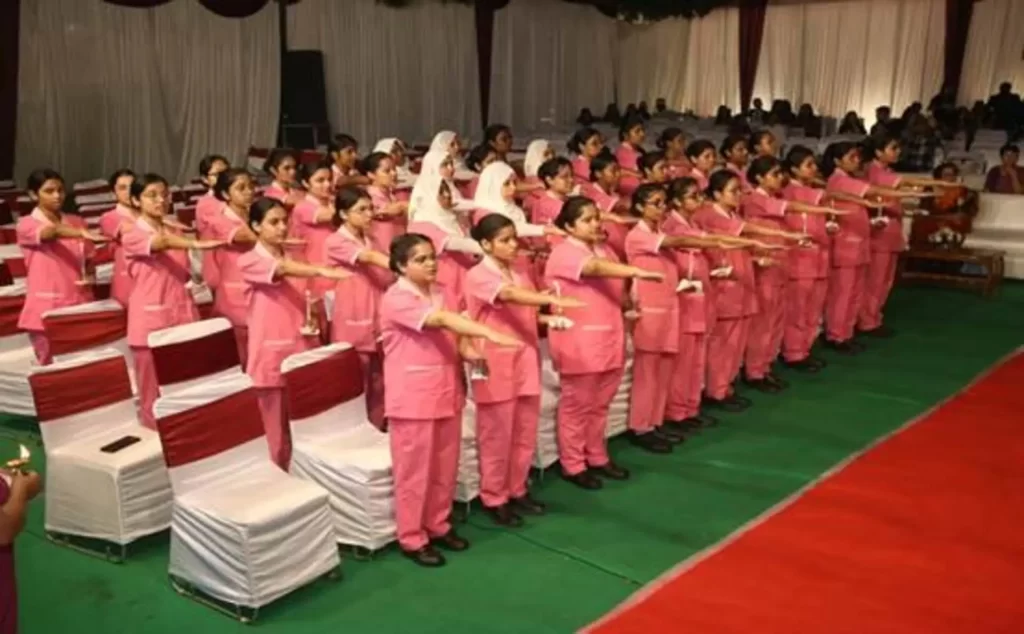
The Nightingale Pledge was then administered by Mrs. Sarita Shokandha, Academic In-Charge, reaffirming the young nurses’ dedication to the ideals of the nursing profession. During the ceremony, degrees were conferred upon the graduates, and meritorious students were felicitated for their outstanding achievements.
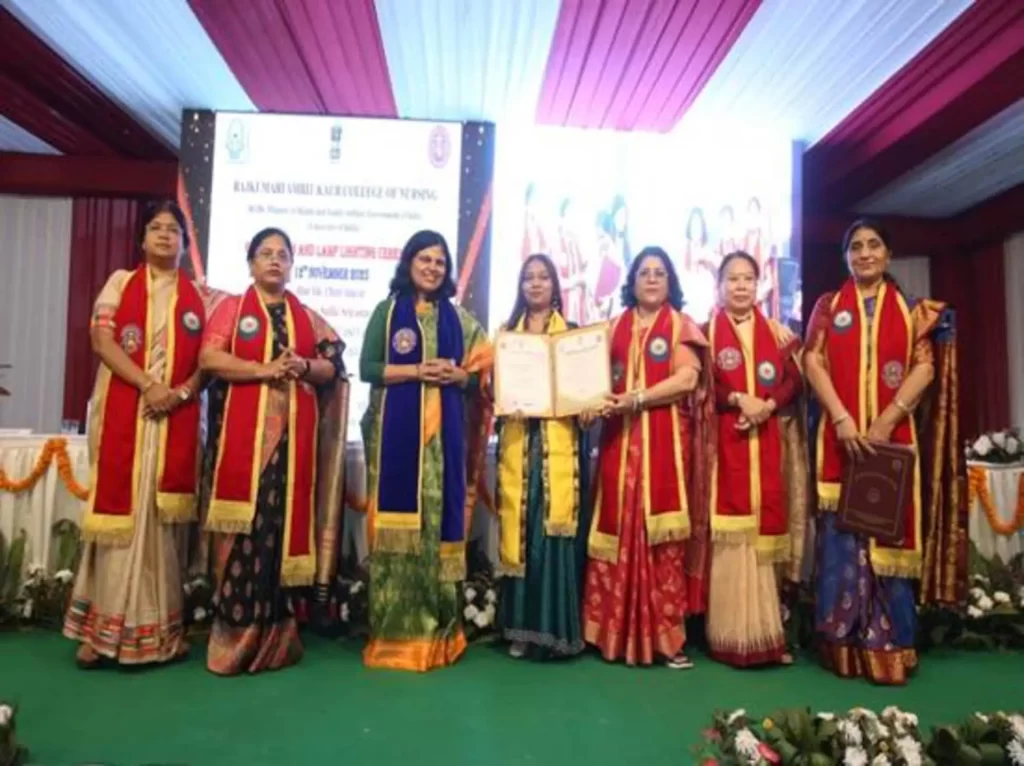
The ceremony concluded with a deep sense of pride and accomplishment as graduates, faculty, and families celebrated this momentous milestone. The event served as an inspiring reminder of the noble responsibilities entrusted to nurses and marked the beginning of a new chapter in the lives of future health professionals dedicated to excellence, empathy, and service to society.
The Union Cabinet chaired by the Prime Minister, Shri Narendra Modi has approved the Export Promotion Mission (EPM) — a flagship initiative announced in the Union Budget 2025–26 to strengthen India’s export competitiveness, particularly for MSMEs, first-time exporters, and labour-intensive sectors.
The Mission will provide a comprehensive, flexible, and digitally driven framework for export promotion, with a total outlay of Rs.25,060 crore for FY 2025–26 to FY 2030–31. EPM marks a strategic shift from multiple fragmented schemes to a single, outcome-based, and adaptive mechanism that can respond swiftly to global trade challenges and evolving exporter needs.
EPM is anchored in a collaborative framework involving the Department of Commerce, Ministry of MSME, Ministry of Finance, and other key stakeholders including Financial Institutions, Export Promotion Councils, Commodity Boards, industry associations, and state governments.
The Mission will operate through two integrated sub-schemes:
EPM consolidates key export support schemes such as the Interest Equalisation Scheme (IES) and Market Access Initiative (MAI), aligning them with contemporary trade needs.
The Mission is designed to directly address structural challenges that constrain Indian exports, including:
· limited and expensive trade finance access,
· high cost of compliance with international export standards,
· inadequate export branding and fragmented market access, and
· logistical disadvantages for exporters in interior and low-export-intensity regions.
Under EPM, priority support will be extended to sectors impacted by recent global tariff escalations, such as textiles, leather, gems & jewellery, engineering goods, and marine products. The interventions will help sustain export orders, protect jobs, and support diversification into new geographies.
The Directorate General of Foreign Trade (DGFT) will act as the implementing agency, with all processes — from application to disbursal — being managed through a dedicated digital platform integrated with existing trade systems.
The Mission is expected to:
· facilitate access to affordable trade finance for MSMEs,
· enhance export readiness through compliance and certification support,
· improve market access and visibility for Indian products,
· boost exports from non-traditional districts and sectors, and
· generate employment across manufacturing, logistics, and allied services.
EPM represents a forward-looking effort to make India’s export framework more inclusive, technology-enabled, and globally competitive, aligning with the vision of Viksit Bharat @2047.
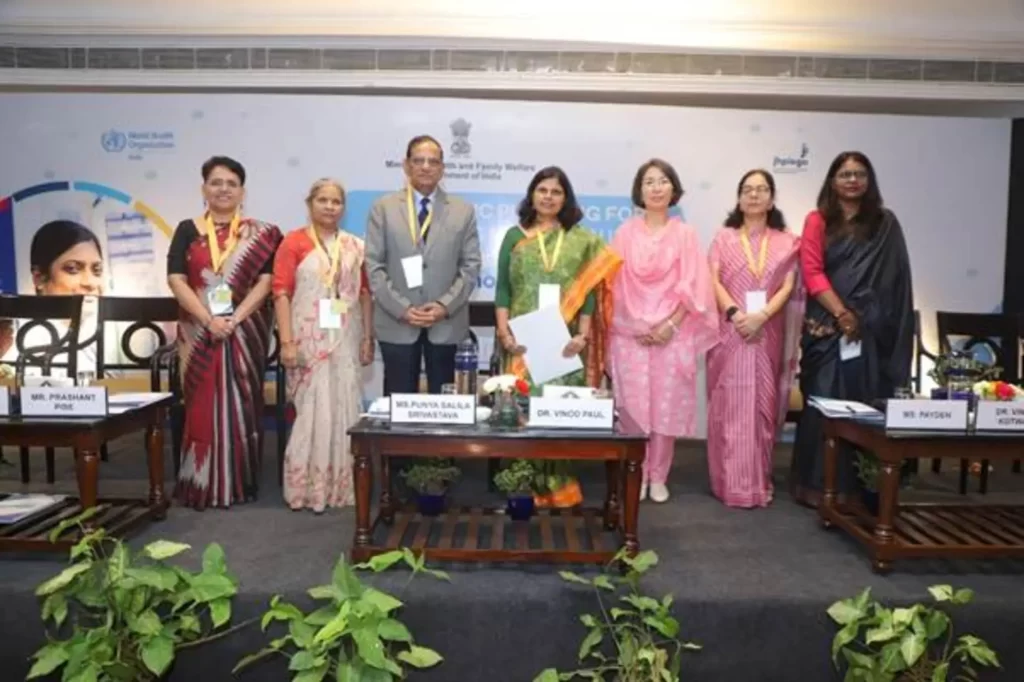
Union Ministry of Health and Family Welfare, in collaboration with the World Health Organization (WHO) and Jhpiego, convened a three-day National Consultation and Experience Sharing Workshop, starting today, on Nursing Policy Priorities and Best Practices in India to strengthen policy dialogue and advance reforms in the nursing and midwifery sector.
The workshop brought together key stakeholders including policymakers, senior government officials, regulators, nursing educators, professional associations, and development partners from across the country. The consultation aimed to review ongoing initiatives, identify emerging challenges, and share innovative models to strengthen nursing governance, education, and workforce management in alignment with India’s health sector priorities and the Sustainable Development Goals (SDGs).
Addressing the gathering, Smt. Punya Salila Srivastava, Union Health Secretary, highlighted that nurses and midwives form the backbone and one of the most important pillars of India’s healthcare system. She emphasized that, along with Ayushman Aarogya Mandir and ASHA workers, they are instrumental in achieving Universal Health Coverage (UHC).
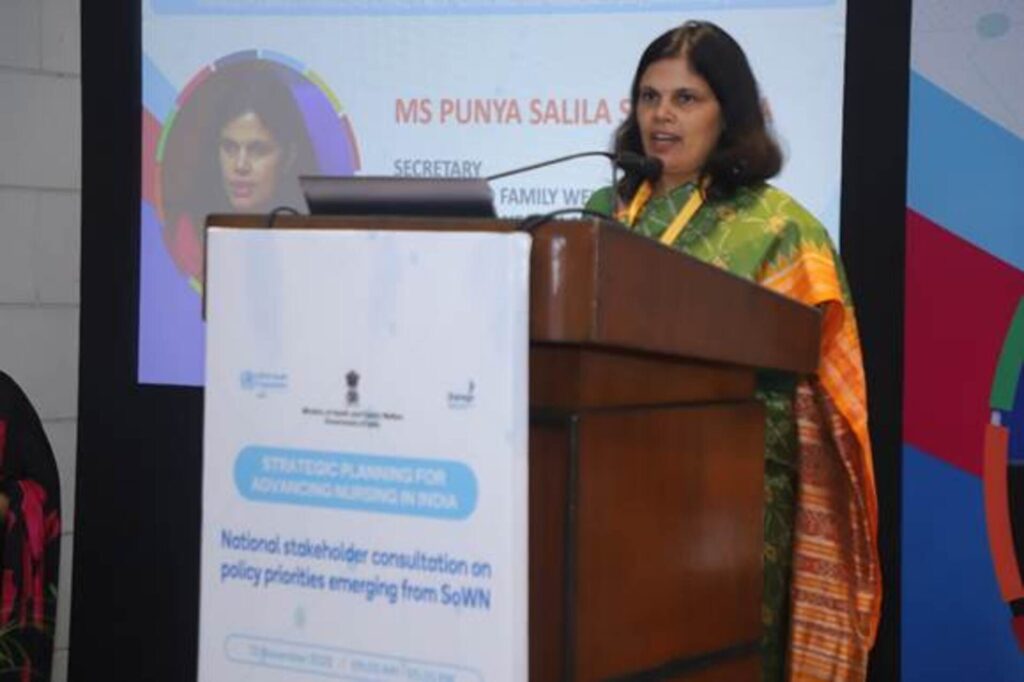
She also noted that, India’s recent reforms, including the establishment of the National Nursing and Midwifery Commission (NNMC), adoption of competency-based curricula, and initiatives to modernize regulatory frameworks, are major milestones in strengthening the nursing ecosystem.
She further underscored that the best practices emerging from each State during this workshop should serve as guiding inputs for national policy formulation, and other States should take note of these models for wider replication and improvement of the nursing sector across the country.
Speaking at the occasion, Professor V.K. Paul, Member Health, Niti Aayog, commended the Ministry of Health and Family Welfare and WHO for convening this important consultation. India’s health system is globally recognized for providing quality healthcare, owing significantly to the strength and dedication of its nursing workforce. He reiterated that nursing is the backbone of India’s comprehensive healthcare system, He added.
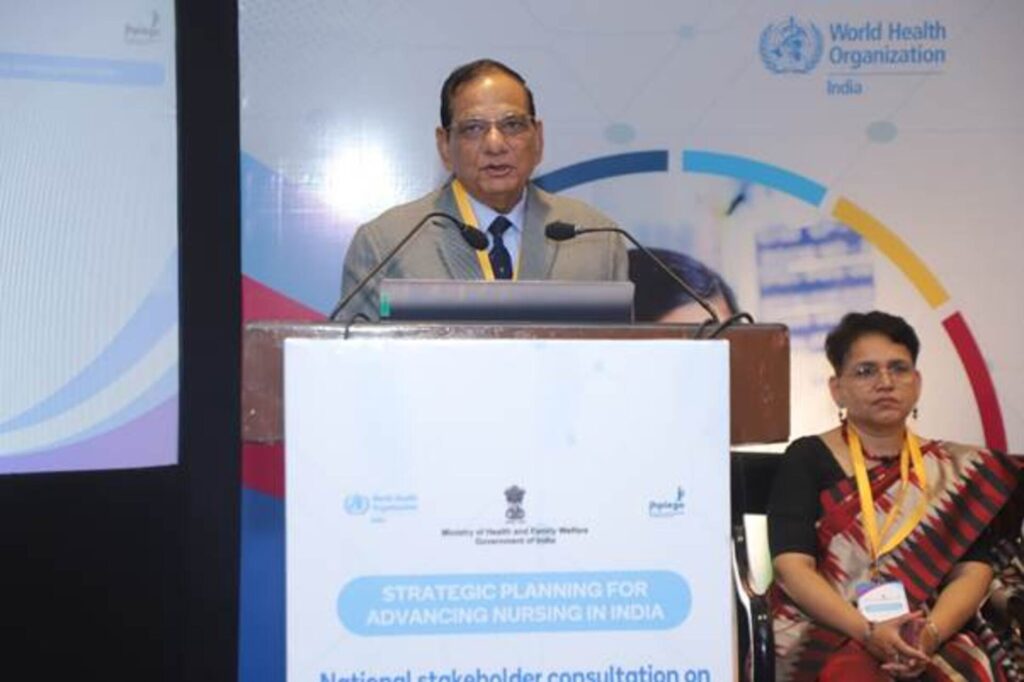
Expressing concern over the quality of training of nurses, Dr. Paul noted that this remains a critical area of focus. He stressed the need for reforms in nursing education and called for greater emphasis on in-service training and skill enhancement to ensure high standards of care and professional excellence.
Speaking at the occasion, Dr. Payden, WHO Representative to India, lauded the country’s significant progress in advancing the nursing and midwifery sector. She highlighted that India has emerged as one of the world’s largest contributors to the global nursing workforce. Dr. Payden also observed that the projected decline in the shortage of nurses in the WHO South-East Asia Region by 2030 can be largely attributed to the advancements and policy initiatives undertaken by India.
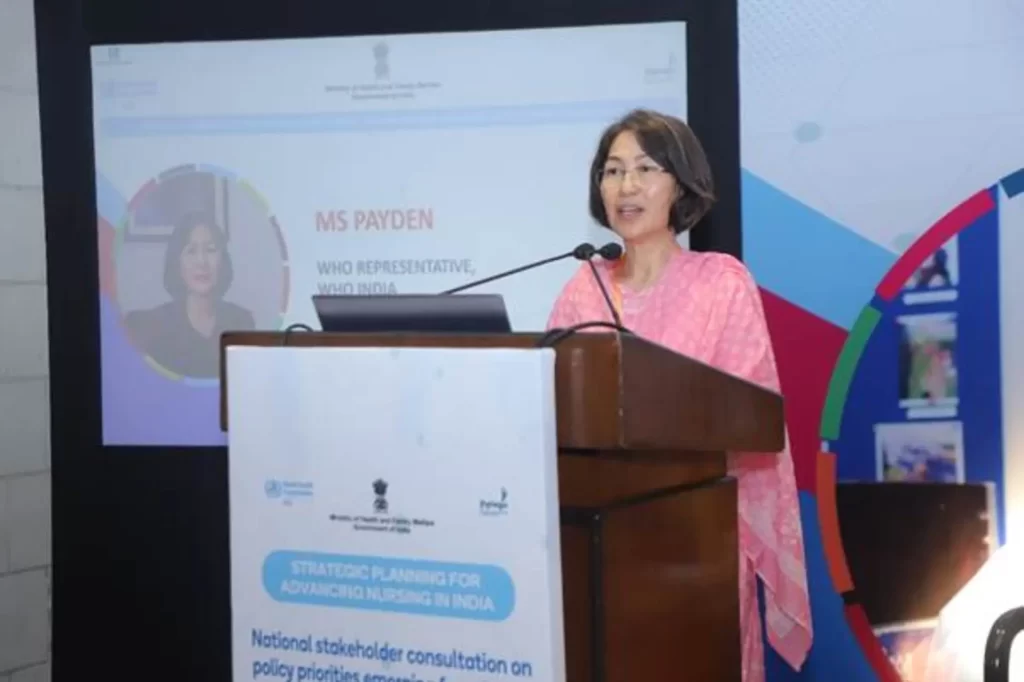
Participants deliberated on policy priorities such as equitable workforce distribution, quality assurance in education and training institutions, leadership development, and career progression opportunities for nursing professionals. They emphasized the importance of aligning national nursing strategies with the findings of the State of the World’s Nursing 2025 Report, and leveraging international collaborations to advance capacity-building and best practices.
Over the three days, the workshop will feature technical sessions, panel discussions, and state presentations showcasing innovations in nursing education, workforce planning, and digital learning. The deliberations aim to foster evidence-based policymaking and cross-learning among states to ensure a resilient, skilled, and empowered nursing workforce across India.
For further reference, the World Health Organization’s “State of the World’s Nursing Report” provides a comprehensive overview of global nursing workforce trends and priorities. The report can be accessed here: https://www.who.int/publications/i/item/9789240110236
The Quality Council of India (QCI), in association with Bharat Heavy Electricals Limited (BHEL), organized the Inter PSU Gunvatta Manthan at its headquarters in New Delhi.
Discussions during the event underlined QCI’s role in advancing the national quality movement through structured frameworks and excellence models. Participating PSUs shared their experiences and initiatives in areas such as Six Sigma, Lean, Quality Circles, Total Productive Maintenance (TPM), digital automation and supplier development programmes. The interactive session enabled benchmarking of practices and identification of areas for improvement.
The initiative aimed to strengthen collaboration and cross-learning among PSUs, aligning with QCI’s vision of developing globally competitive and quality-driven institutions contributing to the objectives of Viksit Bharat 2047.
The event, led by Head, Corporate Quality and Business Excellence, BHEL, Dr. Durgesh C. Gupta, in collaboration with the National Accreditation Board for Certification Bodies (NABCB) – QCI, brought together Central Public Sector Enterprises (CPSEs) including BEL, BPCL, EIL, GAIL, IOCL, PGCIL and THDC. The platform facilitated the exchange of best practices in quality management, business excellence, operational efficiency, supply chain quality, digital transformation and sustainability-oriented performance.
Chairperson, QCI, Shri Jaxay Shah stated that QCI remains committed to strengthening the quality ecosystem across Indian industry, including PSUs and the private sector. He noted that the Inter PSU Gunvatta Manthan represents a constructive step towards promoting a culture of quality and excellence in industrial operations.
Director (R&D), BHEL, Shri S. M. Ramanathan, in his keynote address, highlighted the important role of PSUs in India’s socio-economic development. He emphasized the need for simplicity and effectiveness from design to delivery, ensuring that quality outcomes translate into improved customer satisfaction and operational efficiency.
Chairperson, NABCB, Dr. Ravi P. Singh reaffirmed the importance of a credible and competent quality assurance framework across enterprises. He stressed the need to strengthen conformity assessment mechanisms to enhance the reliability and international standing of Indian quality systems.
The event concluded with a joint session led by QCI and BHEL, outlining potential models for institutional collaboration, including tailored quality partnerships and maturity enhancement programmes. The Inter PSU Gunvatta Manthan reaffirmed the commitment of QCI and BHEL to promoting quality-oriented governance and operational excellence across India’s public sector enterprises.
India’s TB incidence (new cases emerging each year) reduced by 21% – from 237 per lakh population in 2015 to 187 per lakh population in 2024 – over almost double the pace of the decline observed globally at 12 %, as per the World Health Organization’s Global TB Report 2025. This is one of the highest declines in TB incidence globally, outpacing reductions noted among other high-burden countries.
India’s innovative case finding approach, driven by the swift uptake of newer technologies, decentralization of services and large scale community mobilization, has led to the country’s treatment coverage to surge to over 92% in 2024, from 53% in 2015 – with 26.18 lakh TB patients being diagnosed in 2024, out of an estimated incidence of 27 lakh cases. This has helped reduce the number of “missing cases” – those who had TB but were not reported to the programme – from an estimated 15 lakhs in 2015 to less than one lakh in 2024. Also there is no significant increase in the number of MDR TB patients in the country. Treatment success rate under the TB Mukt Bharat Abhiyan increases to 90%, ahead of global treatment success rate of 88%.
Similarly, India’s TB mortality rate has decreased from 28 per lakh population in 2015 to 21 per lakh population in 2024, reflecting significant progress in reducing deaths due to TB. This progress has been achieved through strong government commitment evidenced by a historic near-ten-fold increase in government funding to the TB programme over last 09 years.
Since its launch in December 2024, India’s flagship TB elimination mission, the TB Mukt Bharat Abhiyan has achieved extensive reach, screening over 19 crore vulnerable individuals for TB across the country leading to the detection of over 24.5 lakh TB patients, including 8.61 lakh asymptomatic TB cases. This proactive approach draws on both global and local evidence underscoring the prevalence of asymptomatic (sub-clinical) TB in high-burden settings.
India’s commitment to early detection is backed by the largest TB laboratory network in the world, comprising 9391 rapid molecular testing facilities and 107 culture & drug susceptibility testing laboratories. In addition, to bolster community screening efforts, over 500 AI-enabled hand-held chest x-ray units are available across the country, with an additional 1,500 machines being delivered to the States/UTs. Through 1.78 lakh Ayushman Arogya Mandirs across the country, the programme has been able to decentralize services and take TB care closer to communities.
The Ministry of Health and Family Welfare has also expanded nutritional support provided to TB patients. The Direct Benefit Transfer (DBT) under the Ni-kshay Poshan Yojana (NPY) was increased from ₹500 to ₹1000 per month per patient for the entire treatment duration. Since its launch in April 2018, ₹4,406crores have been disbursed directly into the bank accounts of 1.37crore beneficiaries. Furthermore, to date, 6,77,541 individuals and organizations have enrolled as Ni-kshay Mitras and distributed over 45 lakh food baskets to TB patients, reflecting a strong and growing public-private-community partnership in India’s fight against TB.In a strong demonstration of whole-of-society engagement, the Ministry has also harnessed the energy of over 2 lakh youth volunteers to strengthen community participation in the fight against TB. Over 2 lakh My Bharat volunteers have come forward to serve as Ni-kshay Mitras, providing psychosocial support and encouragement to TB patients across the country. This vibrant youth-led movement reflects India’s commitment to making TB elimination a people’s movement and ensuring that no patient feels alone on their journey to recovery.
The Ministry has also scaled up a differentiated TB care approach across the country, whereby high risk TB patients are identified based on clinical parameters and presence of co-morbidities that impact treatment outcomes and are accordingly provided individualised and tailored treatment to ensure recovery. Also the ASHA workers have been trained to identify early warning signs in TB patients in their areas for reffering the TB patients immedialy to higher treatment facilities.
Under the able leadership, guidance and directions of honourable Prime Minister, the TB Mukt Bharat Abhiyan will continue to focus on pro-actively screening all vulnerable population including asymptomatics & individuals in congregate settings through hand-held X-rays, early detection of all patients using upfront molecular diagnostics and providing them with comprehensive high-quality care – treatment, nutritional and psychosocial support to ensure full recovery and prevention of community transmission. This integrated approach will further reduce TB incidence and mortality, bringing the country closer to the goal of a TB-Mukt Bharat.
Union Minister of Commerce & Industry, Shri Piyush Goyal, while addressing the 22nd CII Annual Health Summit in New Delhi today, pointed out that India’s healthcare sector has benefitted from the Government’s continued focus on affordability—such as reducing GST on health and life insurance from 18 per cent to 0 per cent, and lowering duties on medical devices, cancer care drugs and several essential medicines to make treatments more accessible and affordable for citizens.
Shri Goyal said that the Government is open to exploring further reductions in duties or cesses on essential medicines and medical products to ensure that more medicines are available at affordable prices. The Minister said that the Government would be happy to receive specific inputs from the industry on medicines and products that could benefit from further reduction in duties. He assured the industry that this is a listening government, receptive to feedback, suggestions and ideas, and committed to working collaboratively with stakeholders to strengthen both domestic healthcare delivery and medical value travel.
Shri Goyal added that all such collective efforts—by the Government, medical professionals, and the healthcare industry—will cumulatively help in serving the people of India better and in positioning the country as a preferred global destination for medical treatment and wellness.
The Minister also spoke about the success of Jan Aushadhi Kendras, which have crossed the 10,000 mark, providing affordable generic medicines and sanitary products at nominal prices. He said such interventions have greatly improved healthcare access for rural and economically weaker citizens, ensuring affordability at the grassroots level.
Shri Goyal emphasised that India’s healthcare model must remain inclusive and equitable, saying that “we cannot have a chalk and cheese system where local citizens are deprived of quality healthcare while focusing only on international medical tourism.” He stressed that a strong domestic healthcare foundation is essential for India to emerge as a preferred global hub for medical value travel.
During his address, Shri Goyal highlighted that “good health is the foundation of a thriving society,” echoing the vision of Prime Minister Shri Narendra Modi. He stated that as India moves towards becoming Viksit Bharat by 2047, the role of doctors and the entire medical ecosystem will be crucial in shaping a healthy and productive nation.
Shri Goyal said that India’s medical fraternity has consistently demonstrated leadership, commitment, and excellence, and there is no better team to make India a global benchmark for quality healthcare. He added that India’s healthcare sector has witnessed remarkable growth over the past decade—both in capacity and quality.
The Minister informed that when the present Government came to power in 2014, India had only 7 All India Institutes of Medical Sciences (AIIMS) and 387 medical colleges. In the last ten years, this number has increased to 23 AIIMS and 706 medical colleges, reflecting the Government’s commitment to expanding access to medical education and healthcare infrastructure. He noted that this expansion will help meet India’s growing demand for doctors while continuing to contribute a pool of world-class medical professionals to the global workforce.
Shri Goyal mentioned that as announced by the Prime Minister from the ramparts of the Red Fort last year, the Government is working to significantly increase the number of medical seats by 2029 to strengthen India’s medical education ecosystem and ensure smarter utilisation of infrastructure.
He noted that through initiatives such as Ayushman Bharat, nearly 700 million people are eligible for free healthcare. He said that the Prime Minister’s compassionate leadership is reflected in the decision to extend free healthcare to all senior citizens above 70 years of age, irrespective of income. Shri Goyal recalled the Prime Minister’s vision that every elderly citizen deserves dignity and security, especially at a time when traditional family care systems are changing.
The Minister welcomed suggestions regarding Visa-on-Arrival and E-Visa facilities for medical tourists, adding that India is already extending such facilities to many countries. Shri Goyal noted that India’s ageing population in comparison to global demographics, and the long waiting periods for medical procedures abroad, offer a unique opportunity for India to emerge as a trusted global healthcare destination. He encouraged the CII to prepare an action agenda outlining steps to improve infrastructure, patient accommodation, and the overall experience of medical tourists.
He suggested that hospitals could consider allowing up to 10 per cent of foreign patients, while contributing a portion of the revenue towards the Ayushman Bharat programme or CSR activities benefitting underprivileged sections. Such a balanced model, he said, would ensure both inclusivity and growth.
Highlighting India’s competitive advantage, Shri Goyal said that India offers world-class medical care at one-third or even one-fourth the cost of treatment in several developed countries. He noted that India’s young population, skilled doctors, technicians, nurses, and caregivers are highly sought after globally and form the backbone of India’s healthcare strength.
He urged leading healthcare institutions to expand training programmes for nurses and caregivers to meet both domestic and international demand. He also expressed openness to exploring policies that could enable NRI doctors to contribute to India’s healthcare ecosystem, subject to consultation with professional bodies such as the Indian Medical Association (IMA).
Concluding his address, Shri Goyal said that India’s healthcare advantage lies in its perfect blend of modern medicine, traditional wellness, and compassionate care. He suggested that ‘Heal in India’ should also integrate Yoga, Ayurveda, meditation, and spiritual tourism to present India as a holistic wellness destination.
“India has the clinical prowess, the wellness heritage, the talent, and the culture of hospitality — the right combination to make India the number one wellness destination in the world,” Shri Goyal added.