
Food Safety and Standards Authority of India (FSSAI) is mandated to lay down science-based standards for articles of food and to regulate their manufacture, storage, distribution, sale and import to ensure availability of safe and wholesome food for human consumption. The implementation and enforcement of the Food Safety and Standards (FSS) Act, 2006 is a shared responsibility between the Central and State Governments.
FSSAI has undertaken awareness measure called 'Aaj se Thoda Kam' to address the adverse effects of consuming foods high in fat, salt, and sugar. It encourages consumers to gradually reduce their intake of fat, salt, and sugar through dietary modifications.
FSSAI has also undertaken awareness campaign "Har Label Kuch Kehta Hai" under the ‘Eat Right India’ movement on social media to promote food safety consciousness and healthy eating habits across India. This awareness campaign focuses on empowering consumers to make informed dietary choices by enhancing their understanding of food labels. Food labels contain crucial information about a product's nutritional value, ingredients, and potential allergens.
FSSAI has notified the Food Safety and Standards (Labelling and Display) Regulations, 2020, which lay down comprehensive provisions relating to the labelling of pre-packaged foods. Further, FSSAI has also notified the Food Safety and Standards (Safe Food and Balanced Diets for Children in School) Regulations, 2020 outlining the responsibilities of school authorities to ensure the availability of safe and nutritious food on school premises while also promoting balanced diets in and around school campuses.
FSSAI is fully committed to ensure the availability of safe food products to the consumers across the country. Towards this, regular surveillance, monitoring, inspection and random sampling of various food products are conducted throughout the year by the officials of Food Safety Departments of the respective States/ UTs to check compliance with the quality and safety parameters and other requirements as laid down under FSS Act, 2006, rules & regulations made there under.
The Union Minister of State for Health and Family Welfare, Shri. Prataprao Jadhav stated this in a written reply in the Lok Sabha today.
The Government of India has taken number of steps to reduce dependence on imported active pharmaceutical ingredients (APIs) and promote domestic production. These include the following:
As per the information provided by the Department of Fertilizers, the following steps are taken by the Government every season for ensuring timely and adequate supply of fertilizers across the country, including the remote areas:
As per information provided by the Department of Chemicals and Petrochemicals, various initiatives are being taken to support the sector. The details are as under:
This information was given by Union Minister of State for Chemicals and Fertilizers, Smt. Anupriya Patel, in a written reply in the Lok Sabha today.
There is no provision for Bulk Drug Parks under the Production Linked Incentive (PLI) schemes implemented by the Department of Pharmaceuticals. However, the Department of Pharmaceuticals is implementing another scheme, namely the scheme for Promotion of Bulk Drug Parks, with a budgetary outlay of ₹3,000 crore, under which three bulk drug parks have been approved and are at various stages of development in the States of Andhra Pradesh, Gujarat and Himachal Pradesh, through their respective State implementing agencies. The total project cost of these parks is over ₹6,306.68 crore, with Central assistance to the tune of ₹1,000 crore each for creation of common infrastructure facilities. These parks envisage land and utilities such as power, water, effluent treatment plant, steam, solid waste management and warehouse facilities at a subsidised rate to bulk drug or API manufacturers for units set up in the park. The State implementing agencies of the States concerned have also offered fiscal incentives in the form of capital subsidy on fixed capital investment, interest subsidy, State Goods and Services Tax reimbursement, exemption of stamp duty and registration charges, etc. Further, the scheme provides for applicants for allotment of land in the parks to set up units for manufacturing products prioritised in the PLI Scheme for Bulk Drugs to have priority in land allotment.
While no Bulk Drug Park has been approved for Tamil Nadu under the said scheme, the Government is promoting infrastructure development and investment in the pharmaceutical sector across the country, including Tamil Nadu, through other initiatives such as Scheme for Promotion of Medical Devices Parks and Production Linked Incentive (PLI) Scheme. The details of these schemes are as under:
(i) Scheme for Promotion of Medical Devices Parks: The Scheme for Promotion of Medical Devices Parks aims to provide easy access to world-class, common infrastructure facilities to medical device units set up in medical device parks. Under this scheme, three parks are being set up and are at an advanced stage of development in Greater Noida, Uttar Pradesh, Ujjain, Madhya Pradesh and Kanchipuram, Tamil Nadu. The total project cost of these Parks is ₹871.11 crore, with Central grant-in-aid to the tune of ₹100 crore each for creation of common infrastructure facilities, which is expected to enhance industry’s competitiveness and reduce production costs through optimisation of resources and economies of scale. Civil construction for the three parks is at the final stages. As of December 2025, 199 medical devices manufacturers have been allotted land in the three parks in a 306.64 acre area and 34 units have commenced construction of their plants.
(ii) Production Linked Incentive (PLI) Scheme:
1. PLI Scheme for promotion of domestic manufacturing of critical KSMs/DIs/APIs in India (commonly known as the PLI Scheme for Bulk Drugs): The scheme, which has a total budgetary outlay of ₹6,940 crore, aims to avoid disruption in supply of critical active pharmaceutical ingredients (APIs) used to make critical drugs for which there are no alternatives by reducing supply disruption risk due to excessive dependence on single source. The scheme provides financial incentives on the sale of 41 identified KSMs/ DIs/ APIs products manufactured through greenfield projects set up under the scheme. Under the scheme, 48 projects are approved for manufacturing of 33 bulk drugs, out of which 2 projects are approved from the State of Tamil Nadu.
2. PLI Scheme for Pharmaceuticals: The scheme, which has a total budgetary outlay of ₹15,000 crore, aims to enhance India’s manufacturing capabilities by increasing investment and production in the sector and contributing to product diversification to high-value goods in the pharmaceutical sector. It incentivises production of high-value medicines such as biopharmaceuticals, complex generic drugs, patented drugs or drugs nearing patent expiry, auto-immune drugs, anti-cancer drugs, etc. as well as production of KSMs/ DIs/ APIs other than those notified under the PLI Scheme for Bulk Drugs, thereby contributing to self-reliance. Under the scheme, 55 applicants are approved for manufacturing of pharmaceuticals and in-vitro medical devices (IVDs) manufactured through both greenfield and brownfield projects. 16 manufacturing units are situated in the State of Tamil Nadu.
3. Production Linked Incentive (PLI) scheme for promoting domestic manufacturing of Medical Devices: The scheme has a budgetary outlay of ₹3,420 crore and a five-year performance-linked incentive period from FY2022-23 to FY2026-27. Under the scheme, selected companies are eligible for financial incentive for incremental sales of domestically manufactured medical devices in the radiotherapy, imaging device, anaesthesia, cardio-respiratory and critical care and implant device segments, for a period of five years. Under the scheme, out of total 28 approved projects two have been approved in Tamil Nadu.
The Department of Pharmaceuticals is implementing the scheme for Promotion of Research and Innovation in Pharma-MedTech Sector (PRIP) with an approved outlay of ₹ 5000 crore and scheme duration of up to the financial year 2029-30 to strengthen research and innovation by supporting projects across the innovation lifecycle from early research to product development and commercialisation. Under the scheme, seven Centres of Excellence (CoEs) has been established, one at each National Institute for Pharmaceutical Education and Research, with a focus on strengthening research infrastructure, accelerating innovation, and enhancing industry-academia collaboration in identified areas. Of these, the CoE at NIPER Hyderabad is focused on Bulk Drugs.
The scheme also provides financial assistance to industries, MSMEs, start-ups for eligible R&D projects for the development or expeditious validation of new medicines; complex generics and biosimilars; and novel medical devices in identified priority areas taken up either in-house or in collaboration with the academia. The Scheme would incentivize eligible R&D and innovation projects and promote such activities across States including the state of Tamil Nadu.
At present, there is no such proposal of the Government of India to establish a Bulk Drug Park in the State of Tamil Nadu under the Scheme for Promotion of Bulk Drug Parks.
This information was given by Union Minister of State for Chemicals and Fertilizers, Smt. Anupriya Patel, in a written reply in the Lok Sabha today.
As informed by National Medical Commission (NMC), there is an increase of 48,563 MBBS seats and 29,080 PG seats in the country from Academic Year 2020-21 to 2025-26. The details of the increase in MBBS and PG seats are at Annexure. Furthermore, the Government has approved the addition of 10,023 medical seats under Centrally Sponsored Schemes across government colleges from financial year 2025-26 to 2028-29.
The expansion of medical seats reduces the gap in the healthcare workforce, particularly in underserved region and has a direct bearing on the doctor-population ratio across States. The growing number of medical seats, coupled with improvements in infrastructure and faculty, has made domestic institutions more accessible to Indian students.
NMC, as an apex regulatory body entrusted with the responsibility of maintaining the quality of medical education has notified various Regulations namely Minimum Standards Requirement (MSR), Graduate Medical Education Regulations (GMER), 2023, Maintenance of Standards of Medical Education Regulations, 2023 (MSMER-2023) and Competency-Based Medical Education (CBME) Curriculum Guidelines 2024 to ensure the adherence to prescribed standards in medical education. These regulations are designed to uphold the integrity and quality of medical education and training across the country.
The Union Minister of State for Health and Family Welfare, Smt. Anupriya Patel stated this in a written reply in the Lok Sabha today.
Annexure
Number of MBBS seats from academic year 2020-21 to 2025-26
| Sr. No. | Academic Year | Increase in MBBS seats |
| 1 | 2020-21 | 2963 |
| 2 | 2021-22 | 8790 |
| 3 | 2022-23 | 7398 |
| 4 | 2023-24 | 9652 |
| 5 | 2024-25 | 8641 |
| 6 | 2025-26 | 11119 |
Number of PG seats from academic year 2020-21 to 2025-26
| Sr. No. | Academic Year | Increase in PG seats |
| 1 | 2020-21 | 4983 |
| 2 | 2021-22 | 4705 |
| 3 | 2022-23 | 2874 |
| 4 | 2023-24 | 4713 |
| 5 | 2024-25 | 4186 |
| 6 | 2025-26 | 7619 |
The Janaushadhi product basket consists of 2,110 medicines and 315 medical devices and consumables and it covers major therapeutic groups including cardiovascular disease, oncology, anti-diabetic, anti-infectives, anti-allergic and gastro-intestinal medicines.
The details of sales made by the Kendras located in Konaseema district is as per Annexure II.
While the demographic data sought are not maintained, currently about 15 lakh customers across the country purchase Janaushadhi products daily from JAKs.
Number of steps have been taken to ensure effective and regular supply of medicines including critical and life saving medicines at Jan Aushadhi Kendras (JAKs), including the following:
The District-wise number of JAKs opened in the State of Andhra Pradesh as on 31.12.2025
| S. No. | District | Number of JAKs opened |
| Alluri Sitharama Raju | 2 | |
| Anakapalli | 7 | |
| Ananthapuramu | 12 | |
| Annamayya | 7 | |
| Bapatla | 8 | |
| Chittoor | 12 | |
| Dr. B.R. Ambedkar Konaseema | 8 | |
| East Godavari | 14 | |
| Eluru | 11 | |
| Guntur | 22 | |
| Kakinada | 5 | |
| Krishna | 9 | |
| Kurnool | 20 | |
| Nandyal | 7 | |
| Ntr | 16 | |
| Palnadu | 11 | |
| Parvathipuram Manyam | 3 | |
| Prakasam | 16 | |
| Sri Potti Sriramulu Nellore | 6 | |
| Sri Sathya Sai | 10 | |
| Srikakulam | 9 | |
| Tirupati | 15 | |
| Visakhapatnam | 10 | |
| Vizianagaram | 9 | |
| West Godavari | 14 | |
| Y.S.R. | 9 | |
| Total | 272 | |
Sales at MRP by JAKs opened in Konaseema District:
| S. No. | FY | Sales (Rs. In Cr.) |
| 1 | 2022-23 | 0.04 |
| 2 | 2023-24 | 0.1 |
| 3 | 2024-25 | 0.14 |
| 4 | 2025-26 (till 31.12.2025) | 0.07 |
This information was given by Union Minister of State for Chemicals and Fertilizers, Smt. Anupriya Patel, in a written reply in the Lok Sabha today.
Under Pradhan Mantri Bhartiya Janaushadhi Pariyojana, a total of 17,990 JAKs have been opened across the country as on 31.12.2025. The State-wise /Union Territory-wise number of JAKs opened across the country is at Annexure I. Under the Scheme, dedicated outlets known as Jan Aushadhi Kendras (JAKs) are opened across the country to provide medicines at rates that are about 50% to 80% cheaper than those of equivalent branded alternatives.
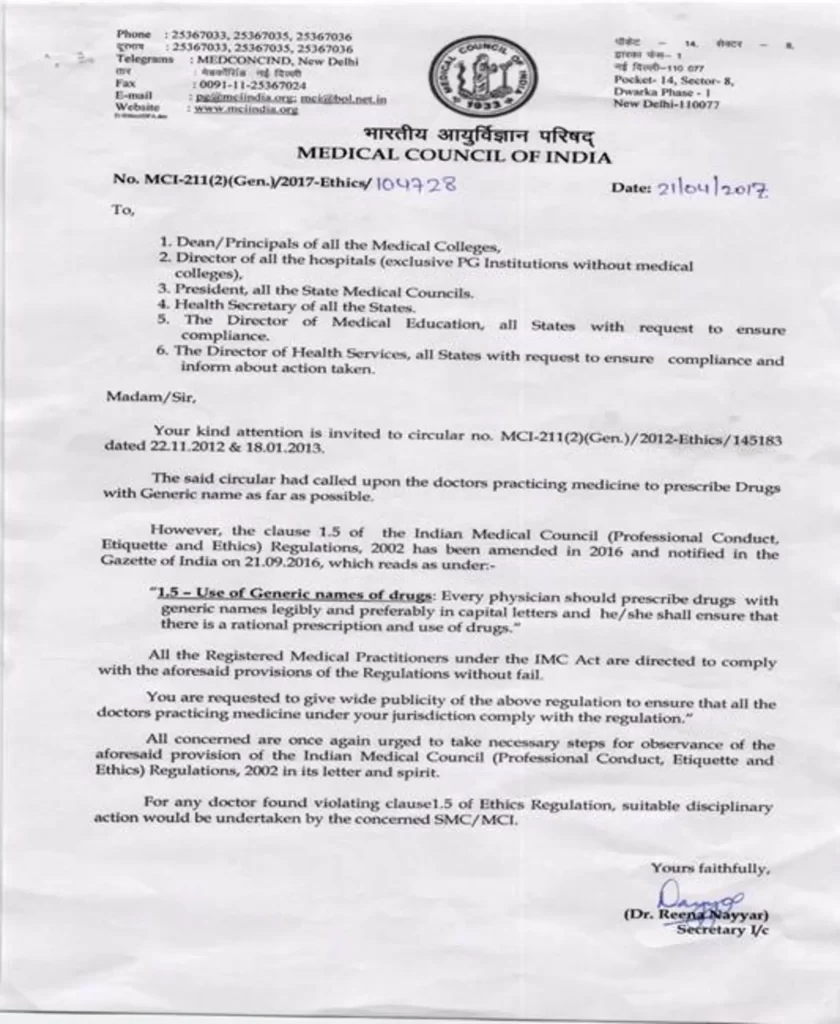
Paragraph 1.5 of the Code of Medical Ethics in the Indian Medical Council (Professional Conduct, Etiquette and Ethics) Regulations, 2002 requires that every physician should prescribe drugs with generic names legibly and preferably in capital letters and that the physician shall ensure that there is a rational prescription and use of drugs. Moreover, the Medical Council of India has issued circular date 21.04.2017 (Annexure II) directing all registered medical practitioners to comply with the said requirement.
In addition to above, the scheme implementing agency i.e. Pharmaceuticals & Medical Devices Bureau of India (PMBI) takes steps to apprise doctors about the scheme and the benefits of generic medicines. The doctors are briefed about the quality and affordability of Janaushadhi medicines through these campaigns. Further, extensive media campaigns are carried out to create awareness among the citizens so that they can request for prescriptions of generic medicines during consultations with their physicians/doctors.
The State-wise /Union Territory-wise number of JAKs opened as on 31.12.2025
| S. No. | State / Union territory | Number of JAKs opened |
| 1 | Andaman and Nicobar Islands | 6 |
| 2 | Andhra Pradesh | 272 |
| 3 | Arunachal Pradesh | 35 |
| 4 | Assam | 176 |
| 5 | Bihar | 1058 |
| 6 | Chandigarh | 19 |
| 7 | Chhattisgarh | 345 |
| 8 | Delhi | 589 |
| 9 | Goa | 18 |
| 10 | Gujarat | 848 |
| 11 | Haryana | 474 |
| 12 | Himachal Pradesh | 74 |
| 13 | Jammu and Kashmir | 351 |
| 14 | Jharkhand | 166 |
| 15 | Karnataka | 1585 |
| 16 | Kerala | 1714 |
| 17 | Ladakh | 3 |
| 18 | Lakshadweep | 1 |
| 19 | Madhya Pradesh | 614 |
| 20 | Maharashtra | 713 |
| 21 | Manipur | 68 |
| 22 | Meghalaya | 25 |
| 23 | Mizoram | 16 |
| 24 | Nagaland | 22 |
| 25 | Odisha | 803 |
| 26 | Puducherry | 33 |
| 27 | Punjab | 532 |
| 28 | Rajasthan | 632 |
| 29 | Sikkim | 15 |
| 30 | Tamil Nadu | 1515 |
| 31 | Telangana | 212 |
| 32 | The Dadra and Nagar Haveli and Daman and Diu | 40 |
| 33 | Tripura | 33 |
| 34 | Uttar Pradesh | 3805 |
| 35 | Uttarakhand | 319 |
| 36 | West Bengal | 859 |
| Total | 17,990 |
Annexure II
Medical Council of India circular date 21.04.2017
This information was given by Union Minister of State for Chemicals and Fertilizers, Smt. Anupriya Patel, in a written reply in the Lok Sabha today.
Under the Pradhan Mantri Bhartiya Janaushadhi Pariyojana (PMBJP) scheme, 11 JAKs have been opened in Jamui Parliamentary Constituency of Bihar. Out of 11 JAKs, 1 Kendra has been opened during F.Y. 2025-26. During the F.Y. 2025-26, the JAKs located in the said constituency have reported a sales turnover of ₹ 1.86 Crore till 31.12.2025.
Out of the 11 JAKs operational in Jamui Constituency, no request has been received for One Time Special Incentive from any SC/ST entrepreneur till 31.12.2025.
Number of steps have been taken to ensure effective and regular supply of medicines including essential diabetes and BP medicines at Jan Aushadhi Kendras (JAKs), including the following:
This information was given by Union Minister of State for Chemicals and Fertilizers, Smt. Anupriya Patel, in a written reply in the Lok Sabha today.
Coronary stents [Bare Metal Stents (BMS) and Drug Eluting Stents (DES)] are included in Schedule-I of the Drugs (Prices Control) Order, 2013 (DPCO, 2013) and accordingly NPPA fixes their ceiling prices as per the provisions of DPCO, 2013. The present applicable ceiling price for BMS is ₹10,692.69 and for DES ₹38,933.14. The prices fixed under DPCO, 2013 are applicable across the country. All manufacturers, marketers and importers of stents are required to sell their products within such ceiling price (plus applicable Goods and Service Tax). Also, NPPA issued a notification dated 12.2.2018, requiring that institutions such as hospitals, nursing homes and clinics performing angioplasty procedures using coronary stents who bill patients directly shall comply with the ceiling prices notified in the notification. Further, the said notification also requires such institutions to specifically and separately mention in their estimate / proforma invoice / final billing, etc. the cost of the coronary stents, its category like bare-metal stent (BMS) or drug-eluting stent (DES), brand name, name of the manufacturer / importer / batch number / specifications and other details.
Further, as per constitutional provisions, ‘Health’ is a State subject. It is the responsibility of respective State Government / Union Territory Administration to take cognizance of cases of excessive amounts being charged by private hospitals and take action to prevent and control such practices. However, the Government of India, enacted ‘The Clinical Establishments (Registration and Regulation) Act, 2010’ (CE Act) and notified ‘The Clinical Establishments (Central Government) Rules, 2012’ thereunder to provide for registration and regulation of Government as well as private clinical establishments belonging to recognized systems of medicine i.e. Allopathy, Yoga, Naturopathy, Ayurveda, Homoeopathy, Siddha and Unani System of medicines, or any other system of medicine as may be recognised by the Central Government (except those of Armed Forces). The State Governments and Union Territories Administration which have adopted the CE Act are primarily responsible for regulating their hospitals including private hospitals as per provisions of the CE Act and Rules thereunder to ensure the provision of affordable and quality healthcare to patients. As per the CE Act, all the clinical establishments (Government & private) are required to fulfil the conditions of minimum standards of facilities and services and inter-alia, display of rates charged by them at a conspicuous place. The CE Act has empowered a registering authority at the District level under the chairmanship of the District Collector / District Magistrate to take actions including imposing penalties in respect of violation of its provisions.
This information was given by Union Minister of State for Chemicals and Fertilizers, Smt. Anupriya Patel, in a written reply in the Lok Sabha today.
As per the information provided by Department of Health & Family Welfare, total 40 Pharmaceutical manufacturing units are currently operational in Daman.
As per the information provided by Ministry of Enviroment, Forest & Climate Change (MoEFCC), all the operational units are having valid authorization for the handling of Hazardous and Bio-medical waste. There is no Common Effluent Treatment Plant (CETP) in Daman and all the pharmaceuticals manufacturing units are operational under Zero Liquid Discharge system. Further, no cases have been registered against any company for violations under the Environment (Protection) Act, 1986.
This information was given by Union Minister of State for Chemicals and Fertilizers, Smt. Anupriya Patel, in a written reply in the Lok Sabha today.
The Production Linked Incentive (PLI) Scheme for Promoting Domestic Manufacturing of Medical Devices aims to promote domestic manufacturing of medical devices by attracting large investments for creation of domestic manufacturing capacity and incentivising domestic production. The list of high-end medical devices that are currently being manufactured in the country under the scheme is at Annexure.
The setting up of a Medical Device Park each in the States of Uttar Pradesh, Madhya Pradesh and Tamil Nadu, under the Scheme for Promotion of Medical Device Parks, is aimed at developing a highly competitive domestic manufacturing ecosystem by creating a state-of-the-art manufacturing ecosystem that offers plug-and-play facilities to greenfield units set up in these parks. Medical Device Parks offer land at substantially subsidised rates, often coupled with exemptions or concessions on stamp duty, which significantly reduces initial capital outlay on land acquisition and project establishment. This upfront cost relief is particularly important for greenfield investors, as it allows a larger share of their capital to be directed towards plant and machinery, technology acquisition, automation and quality systems, rather than land costs and costs of establishing facilities that are being made available as common facilities in these Parks, such as 3D design and printing, electronic assembly, electromagnetic interference and compatibility centre, moulding, sterilisation, biocompatibility testing, toxicology, electronic parts testing, component testing, gamma radiation facility. By providing such facilities on shared basis, the parks eliminate the need for individual companies to invest in expensive, capital-intensive infrastructure that is often under-utilised if set up in-house. This significantly reduces the per-unit cost of manufacturing, testing and validation, while also shortening product development timelines.
The Capacity Building and Skill Development in Medical Device Sector sub-scheme of the Strengthening of Medical Device Industry scheme is currently in the implementation phase. Under this sub-scheme, specialised high-tech manpower is being developed through post-graduate, PG-diploma and skilling programmes in medical devices. Academic institutions under this sub scheme deliver industry-aligned curriculum with hands-on training in medical device design, production, testing and diagnostics, supported by industry exposure, internships and applied research.
So far, 18 projects have been approved, covering over 12 premier institutions, including IITs, NITs, NIPERs, NIMHANS etc. serving to create about 750 high-tech professionals over the next three years.
The Promotion of Research in Pharma-Medtech Sector (PRIP) scheme has been launched by Department of Pharmaceuticals to provide financial assistance for research and development projects of industry, MSMEs and startups in priority areas, including novel medical devices. With a view to help build specific research capacities in medical devices, tapping industry-academia linkage, institutional strengthening of research infrastructure and nurturing of talent pool has been undertaken through the setting up of a Centre of Excellence on medical devices with advanced facilities at the National Institute of Pharmaceutical Education and Research (NIPER), Ahmedabad.
Further, the NIPER Council has set up a NIPER Academia-Industry Coordination Committee as an institutional mechanism to promote strategic coordination between NIPERs and pharmaceuticals and medical devices industry by, among other things, facilitating greater synergies between NIPERs and industry and supporting research-driven growth, innovation, skilling and translation of academic research into industrial applications.
High-end medical devices being manufactured in India under the PLI Scheme
1.Rotational Cobalt Machine
2.Linear Accelerator (LINAC)
3.Laser Ablation System
4.CT Scan
5.MRI
6.MRI Coils
7.Mammography
8.X-ray equipment
9.X- Ray including Fixed Line Frequency (LF) and High Frequency (HF) X-Ray Product
10.C-arm/ Surgical X-Ray C-Arm
11.Cath-Lab
12.PET Detector
13.Digital X-Ray Flat Pannel Detector
14.X - Ray Panels
15.Anesthesia Workstation
16.Anesthesia Unit Ventilators
17.Dialyzer
18.Dialysis Machine
19.Haemodialysis Catheter
20.Peritoneal Dialysis Kits
21.Oxygen Concentrators
22.High Flow Oxygen Devices
23.Intensive Care Ventilators
24.Emergency Ventilators
25.ECG
26.Patient Monitoring System / Patient Monitors
27.Multi-Parameter Monitor
28.Defibrillators / Automated External Defibrillators (AED
29.Bi-Phasic Defibrillators
30.Stress Test System
31.Hip Implants
32.Knee implants
33.Trauma Implants
34.PTCA Balloon Dilation Catheter / PTCA Balloon Catheter/Drug Eluting Balloons
35.Heart Valves
36.Stents/Drug Eluting Stents
37.Intravascular Lithotripsy Catheter System
38.Endocutter
This information was given by Union Minister of State for Chemicals and Fertilizers, Smt. Anupriya Patel, in a written reply in the Lok Sabha today.