
In a significant milestone, India has achieved landmark achievement in further reduction of child mortality rates. As per the Sample Registration System (SRS) Statistical Report 2020 released on 22nd September 2022 by Registrar General of India (RGI), the country has been witnessing a progressive reduction in IMR, U5MR and NMR since 2014 towards achieving the Sustainable Development Goals (SDG) targets by 2030.
Union Health and Family Welfare Minister, Dr Mansukh Mandaviya congratulated the nation on this achievement and thanked all health workers, caregivers and community members for relentlessly working towards reducing child mortality. “There has been sustained decline since 2014, as revealed by SRS 2020. India is poised to meet 2030 SDG targets of child mortality under leadership of Hon. Prime Minister Shri Narendra Modi ji with focused interventions, strong Centre-State partnership and dedication of all health workers”, he stated.
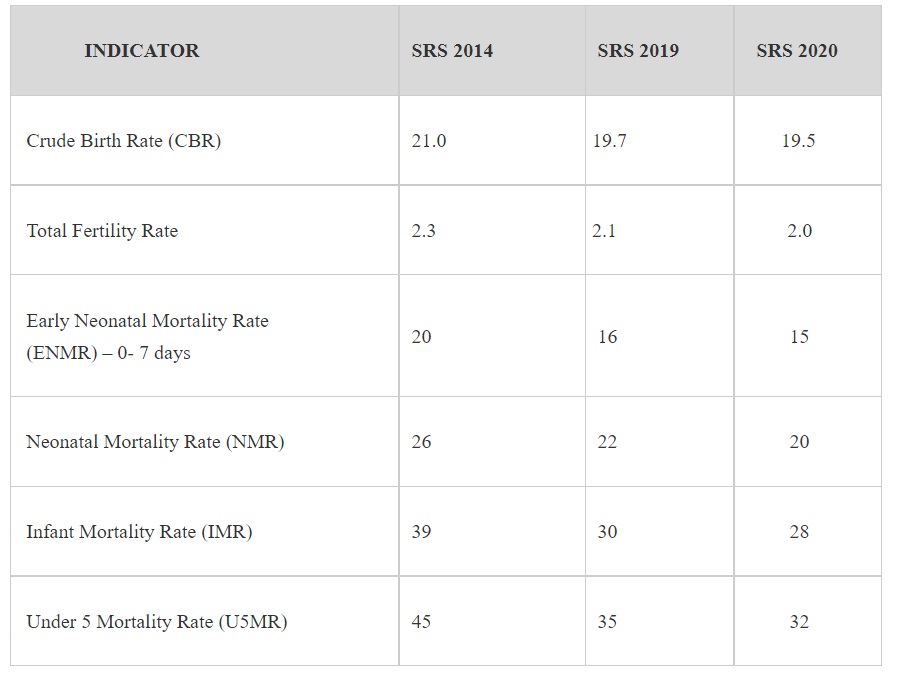
Following a steady downward trend, IMR, U5MR and NMR have further declined:
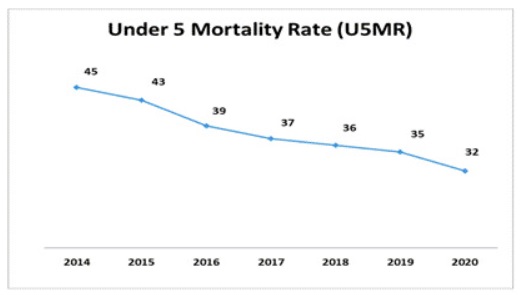
· Under 5 Mortality Rate (U5MR) for the country has shown significant decline of 3 points (Annual Decline Rate: 8.6%) from 2019 (32 per 1000 live births in 2020 against 35 per 1000 live births in 2019). It varies from 36 in rural areas to 21 in urban areas.
U5MR for Female is higher (33) than male (31). There has been a decline of 4 points in male U5MR and 3 points in female U5MR during the corresponding period.
Highest decline of U5MR is observed in the State of Uttar Pradesh (5 points) and Karnataka (5 points)
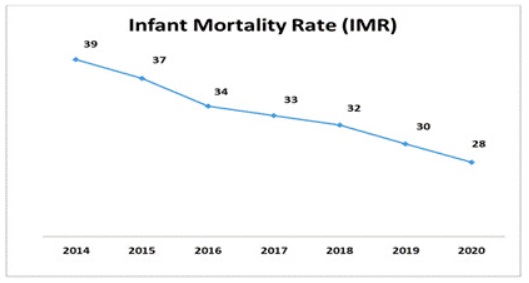
Infant Mortality Rate (IMR) has also registered 2-point decline to 28 per 1000 live births in 2020 from 30 per 1000 live births in 2019 (Annual Decline Rate: 6.7%).
The Rural-Urban difference has narrowed to 12 points (Urban 19, Rural-31).
No gender differential has observed in 2020 (Male -28, Female - 28).
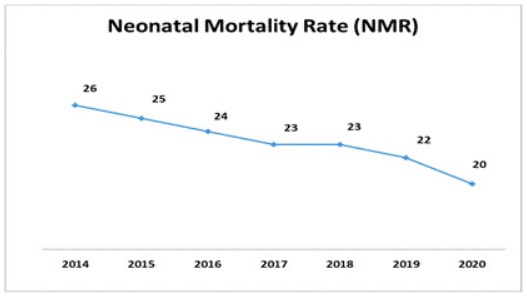
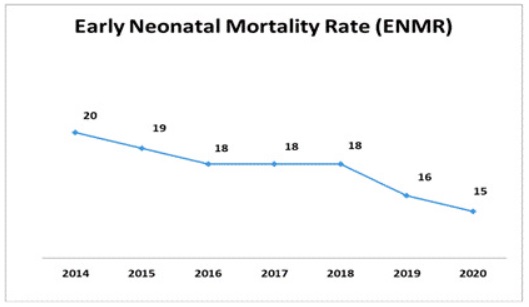
Neonatal Mortality Rate has also declined by 2 points from 22 per 1000 live births in 2019 to 20 per 1000 live births in 2020 (Annual Decline Rate: 9.1%). It ranges from 12 in urban areas to 23 in rural areas.
As per SRS 2020 Report,
Six (6) States/ UT have already attained SDG target of NMR (<=12 by 2030): Kerala (4), Delhi (9), Tamil Nadu (9), Maharashtra (11), Jammu & Kashmir (12) and Punjab (12).
Eleven (11) States/UT have already attained SDGs target of U5MR (<=25 by 2030): Kerala (8), Tamil Nadu (13), Delhi (14), Maharashtra (18), J&K (17), Karnataka (21), Punjab (22), West Bengal (22), Telangana (23), Gujarat (24), and Himachal Pradesh (24).
Dr. Mansukh Mandaviya, Union Minister of Health & Family Welfare will inaugurate “Arogya Manthan 2022” on 25th September, 2022 to celebrate four years of implementation of Ayushman Bharat Pradhan Mantri – Jan Arogya Yojana (AB PM-JAY) and one year of implementation of Ayushman Bharat Digital Mission (ABDM). Shri Ashwini Vaishnaw, Minister for Electronics & Information Technology, Dr. Bharati Pravin Pawar, Minister of State for Health and Family Welfare and Dr V. K. Paul, Member (Health), NITI Aayog will grace the event. Senior Government officials from the states/UTs will also be present. The two-day event will see active participation from global and national experts from the healthcare sector along with representatives from academia, think-tanks, industry, and media.
The Union Health Minister will kick-start the celebrations by interacting with beneficiaries of AB-PMJAY from across the country on 23rd September 2022.
AB-PMJAY will complete four years of its implementation on 23rd September 2022 and Ayushman Bharat Digital Mission (ABDM) will be marking its first anniversary on 27th September 2022. Fortnight-long celebration in the form of ‘Ayushman Pakhwara' to mark the anniversary of AB- MJAY is already underway in all states implementing the scheme, from 15th to 30th September 2022. Under the ‘Ayushman Pakhwara’, 33 states and UTs participating in AB-PMJAY are organizing awareness programs, health check-up camps and mass drives for Ayushman Card generation for beneficiaries of the scheme.
A Digi Health Expo will bring innovators from public and private sector exhibiting innovative digital health solutions.
The two-day event will have a total of twelve sessions covering a comprehensive list of agenda. Day-1 will have sessions on Universal Health Coverage in India, Promoting Interoperability in Digital Health, Enhancing the Efficiency of PM-JAY, Adoption of Digital Health, Health Technology Assessment for Evidence Informed PM-JAY Decisions and Privacy and Security Issues related to Digital Health. Sessions lined up for Day-2 include Best Practices by States Implementing ABDM, Digital Health Insurance in India, PM-JAY Best Practices by States, International Best Practices in Digital Health, Ensuring Access, Affordability and Quality in Healthcare through PM-JAY and Way Forwards for Digital Health in India.
NHA will also present the Ayushman Utkrishtata Puraskaar 2022 (Ayushman Excellence Awards) to felicitate the top performing states, PMAMs (Pradhan Mantri Arogya Mitra) and public hospitals under the AB PM-JAY and best performing states/ UTs, districts, private & government health facilities and digital health solutions under ABDM. The winners of ABDM Hackathon Series Round 1 will also be awarded at the ceremony.
Dr. Mansukh Mandaviya, Union Minister of Health & Family Welfare will inaugurate “Arogya Manthan 2022” on 25th September, 2022 to celebrate four years of implementation of Ayushman Bharat Pradhan Mantri – Jan Arogya Yojana (AB PM-JAY) and one year of implementation of Ayushman Bharat Digital Mission (ABDM). Shri Ashwini Vaishnaw, Minister for Electronics & Information Technology, Dr. Bharati Pravin Pawar, Minister of State for Health and Family Welfare and Dr V. K. Paul, Member (Health), NITI Aayog will grace the event. Senior Government officials from the states/UTs will also be present. The two-day event will see active participation from global and national experts from the healthcare sector along with representatives from academia, think-tanks, industry, and media.
The Union Health Minister will kick-start the celebrations by interacting with beneficiaries of AB-PMJAY from across the country on 23rd September 2022.
AB-PMJAY will complete four years of its implementation on 23rd September 2022 and Ayushman Bharat Digital Mission (ABDM) will be marking its first anniversary on 27th September 2022. Fortnight-long celebration in the form of ‘Ayushman Pakhwara' to mark the anniversary of AB- MJAY is already underway in all states implementing the scheme, from 15th to 30th September 2022. Under the ‘Ayushman Pakhwara’, 33 states and UTs participating in AB-PMJAY are organizing awareness programs, health check-up camps and mass drives for Ayushman Card generation for beneficiaries of the scheme.
A Digi Health Expo will bring innovators from public and private sector exhibiting innovative digital health solutions.
The two-day event will have a total of twelve sessions covering a comprehensive list of agenda. Day-1 will have sessions on Universal Health Coverage in India, Promoting Interoperability in Digital Health, Enhancing the Efficiency of PM-JAY, Adoption of Digital Health, Health Technology Assessment for Evidence Informed PM-JAY Decisions and Privacy and Security Issues related to Digital Health. Sessions lined up for Day-2 include Best Practices by States Implementing ABDM, Digital Health Insurance in India, PM-JAY Best Practices by States, International Best Practices in Digital Health, Ensuring Access, Affordability and Quality in Healthcare through PM-JAY and Way Forwards for Digital Health in India.
NHA will also present the Ayushman Utkrishtata Puraskaar 2022 (Ayushman Excellence Awards) to felicitate the top performing states, PMAMs (Pradhan Mantri Arogya Mitra) and public hospitals under the AB PM-JAY and best performing states/ UTs, districts, private & government health facilities and digital health solutions under ABDM. The winners of ABDM Hackathon Series Round 1 will also be awarded at the ceremony.
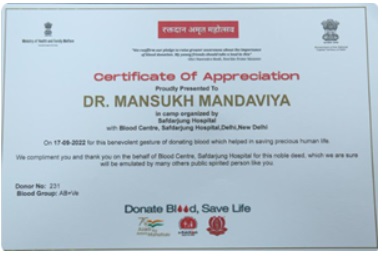
“Blood donation is a noble cause and given our rich culture and tradition of Seva and Sahyog, I urge and appeal to all citizens to come forward and donate blood as part of the countrywide mega voluntary blood donation drive- Raktdaan Amrit Mahotsav. Donating blood not just fulfils the national requirement but also is a great service to society & humanity”. This was stated by Union Minister for Health & Family Welfare, Dr. Mansukh Mandaviya while donating blood at the blood donation camp at Safdarjung Hospital, New Delhi today.
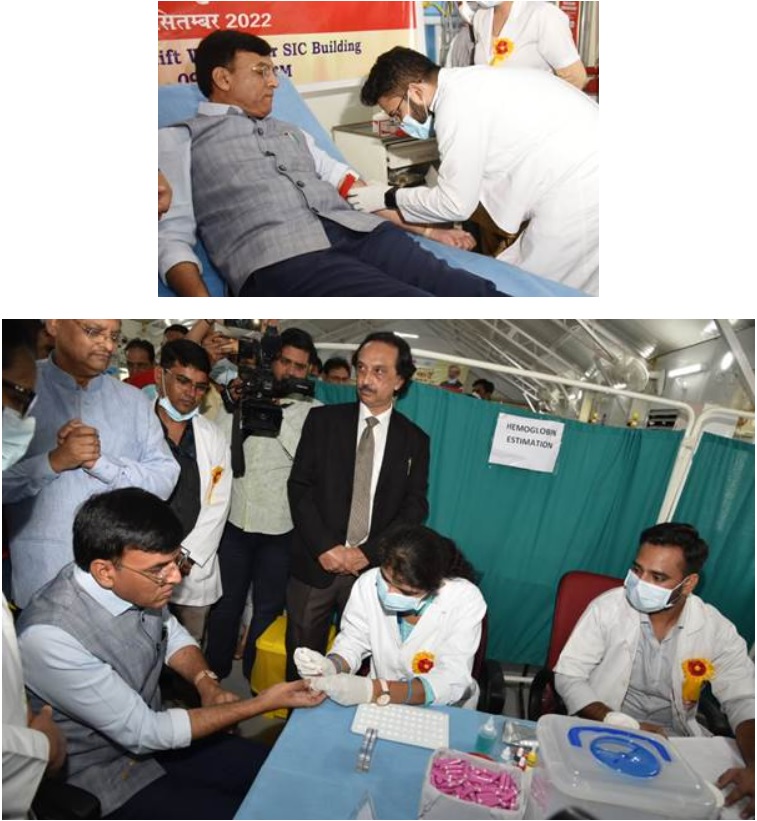
Accentuating the importance of voluntary blood donation, Union Health Minister said, “Raktdaan Amrit Mahotsav is part of bigger celebrations of Azadi ka Amrit Mahostav. The campaign aims to increase awareness regarding regular non-remunerated voluntary blood donations and ensure that blood or its components (whole blood/ packed red blood cells/plasma/platelets) are available, accessible, affordable and safe.” As per 2021 statistics, India’s annual requirement is around 1.5 Cr units. In every two seconds, someone in India needs blood and one out of every three of us will need blood in our lifetime, he stated. “Despite the technological advancements, there remains no alternative to blood and 1 unit of blood can save as many as three lives’, Dr Mandaviya noted.
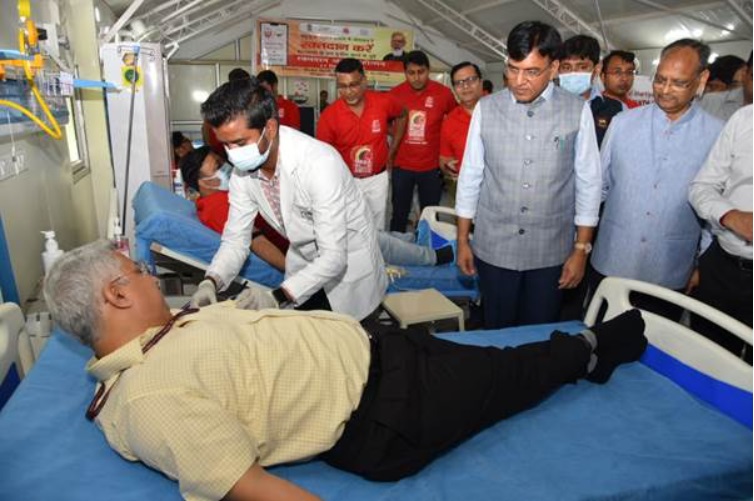
Dr. Mandaviya met the donors at the blood donation camp and appreciated their selfless act of donating blood. Removing myths surrounding blood donation, Dr. Mandaviya stated that “A person has 5 - 6 litres of blood in their body and can donate blood every 90 days (3 months).” Body can recover blood very quickly; blood plasma volume within 24 - 48 hours, red blood cells in about 3 weeks and platelets & white blood cells within minutes.
The nationwide drive is supported by the centralised blood bank management information system called, E-Rakt Kosh portal, which will act as a national repository of blood donors. This will ensure a robust record of blood donors and will expedite blood availability when in need.
Link for E-Rakt Kosh Portal:
https://www.eraktkosh.in/BLDAHIMS/bloodbank/transactions/bbpublicindex.html
Dr. Mandaviya also released the book "Footprints on the Sands of Time" showcasing contributions of Safdarjung Hospital towards India's healthcare.
With more than 87,000 (87,137) people voluntarily donating blood in a single day (as per provisional reports till 7:40 pm today), the country has surpassed the previous best of 87,059 (2014) to create a new world record today. This is a significant achievement in the countrywide mega voluntary blood donation drive, Raktdaan Amrit Mahotsav which was kickstarted by Union Minister for Health & Family Welfare, Dr. Mansukh Mandaviya today by donating blood at a blood donation camp at Safdarjung Hospital, New Delhi. Dr. Mandaviya hailed the extraordinary achievement in his tweet:
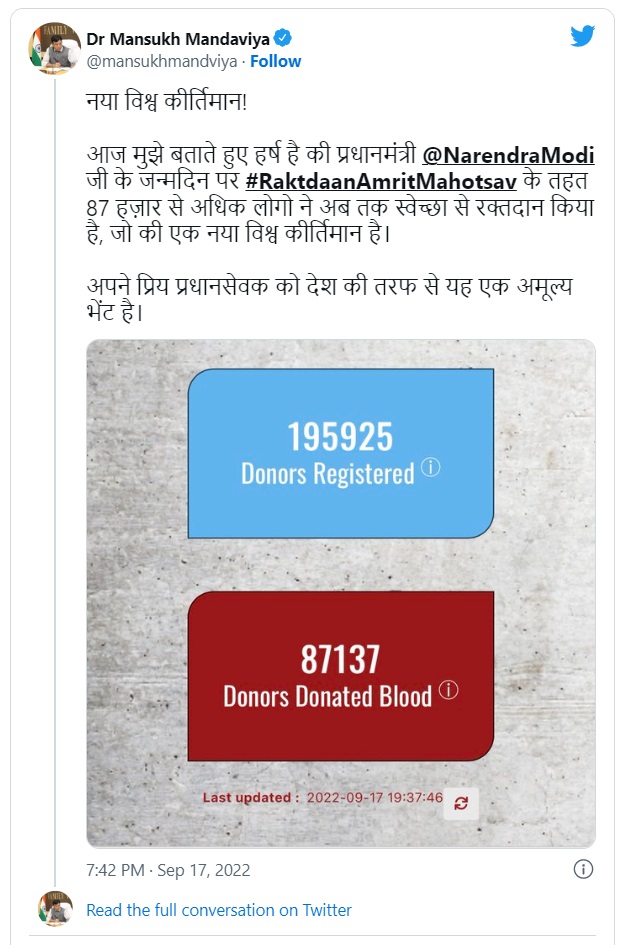
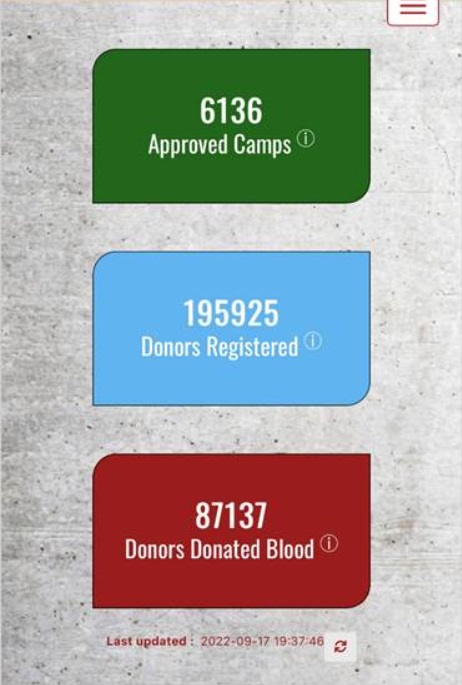
As another remarkable aspect of this nationwide drive, 6,136 camps have been registered for this mega drive along with more than 1.95 lakh blood donors registered so far on E-Rakt Kosh portal (link:https://www.eraktkosh.in/BLDAHIMS/bloodbank/transactions/bbpublicindex.html ).
In another step towards ensuring health for all, Hon’ble President Smt. Droupadi Murmu launched ‘Pradhan Mantri TB Mukt Bharat Abhiyaan’ to eliminate TB by 2025, on 9th September 2022. Pradhan Mantri TB Mukt Bharat Abhiyan is an extension of Hon’ble Prime Minister’s citizen- centric policies and a key step in ensuring enhanced awareness regarding the treatment for TB, a curable disease. The treatment is available free of cost at government health facilities.
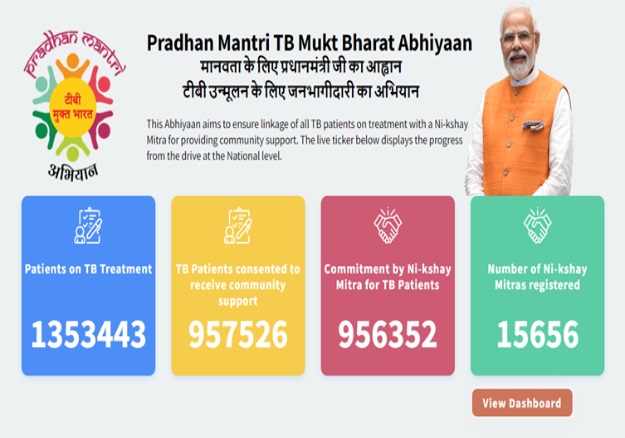
The initiative has gained momentum and so far roughly 13.5 lakh TB patients have registered on the Nikshay portal, out of which 9.5 lakh active TB patients have given their consent for adoption.
The Ni-kshay 2.0 portal ( https://communitysupport.nikshay.in/ ) is facilitating in providing additional patient support to improve treatment outcome of TB patients, augmenting community involvement in meeting India’s commitment to end TB by 2025 and leveraging Corporate Social Responsibility (CSR) opportunities.
Nikshay Mitras can also register on the website and more than 15,000 such mitras have registered so far and shown their commitment to provide support for over 9.5 lakh TB patients.
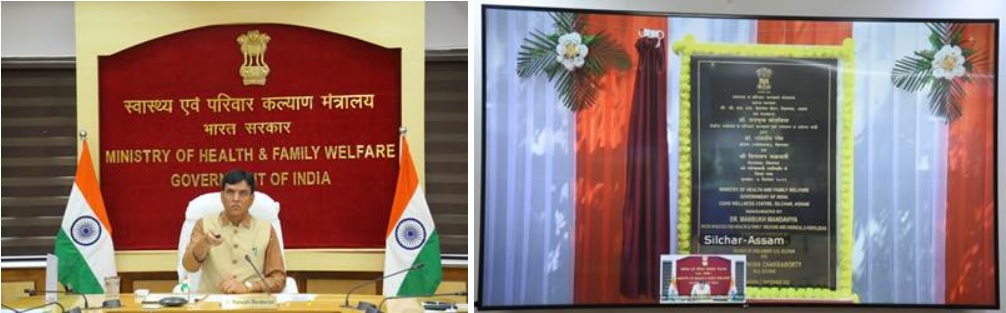
“In a significant achievement to strengthening the country’s health infrastructure and accessibility to CGHS services, there has been a threefold increase in the number of Central Government Health Scheme (CGHS) Wellness Centres. The cities covered by CGHS Wellness Centres have has grown from 25 in 2014 to 75 now. This is in line with vision of Prime Minister Shri Narendra Modi ji to provide easily accessible healthcare services closer to the communities”. This was stated by Union Minister for Health and Family Welfare Dr Mansukh Mandaviya while inaugurating a CGHS Wellness Centre in Silchar today virtually in the presence of Dr. Rajdeep Roy, MP (LS) and Shri Dipayan Chakraborty, MLA from Silchar, Assam.
Union Minister of Health and Family Welfare Dr. Mandaviya reiterated the commitment of the Central Government to providing easily accessible quality healthcare services to the beneficiaries. He stated that the new CGHS centre at Silchar will provide healthcare services to serving and retired Central Government employees residing not only in Silchar but the neighboring districts of Karimganj and Hailakandi and the Barak Valley. He pointed out that despite Silchar being one of the major cities in Barak Valley, beneficiaries had to travel more than 180 km to avail of CGHS facilities from Aizawl or 208 km to Shillong. The new Wellness Centre would cater to the medical needs of several thousands of beneficiaries and would mitigate their hardships, as they will not be required to travel to such far away places now. The Wellness Centre will provide outpatient services including medicines, referral for investigations as well as indoor treatment at Government and EmpanelledHospitals. Cashless facilities for treatment will be provided in empanelled Hospitals.
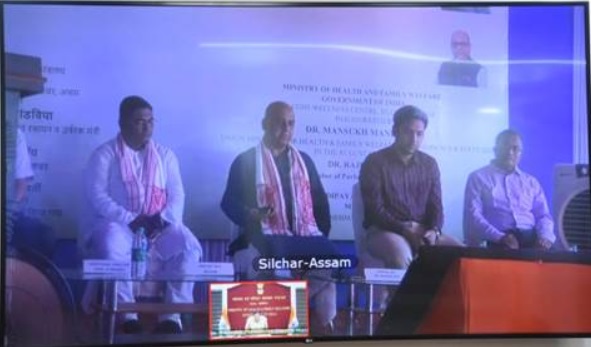
Dr. Mandaviya added that “With the new CGHS Wellness Centre, Silchar is the third city in Assam after Guwahati and Dibrugarh to have CGHS facilities. The Wellness Centre is one of the 16 new CGHS centres being set up across thecountry in the Government’s endeavour to expand the coverage and improve the accessibility of CGHS services”. The Union Health Ministry is working on several fronts to improve the services being provided by CGHS to its beneficiaries. Grievance redressal by daily monitoring in mission mode, expediting bill reimbursements, expanding network of private hospital empanelment and other steps have led to quick reimbursements and a decrease in pendency of such cases, he highlighted.
Dr. Mandaviya also stated that Government of India has taken several steps to boost the health infrastructures in the country. Rs. 64,000 cr under PM-ABHIM (Prime Minister- Ayushman Bharat Health Infrastructure Mission), Rs. 15,000 cr. under ECRP-I and Rs. 23,000 cr under ECRP-II have been approved for strengthening health infrastructure in the states.
The Central Government Health Scheme (CGHS) was started in 1954 with the objective of providing comprehensive health care to Central Government employees and pensioners and their dependent family members. Currently more than 41 lakh beneficiaries in 75 cities are covered by this scheme.
Shri Rajesh Bhushan, Union Health Secretary, Shri Alok Saxena, Additional Secretary, MoHFW, Dr. Nikhilesh Chandra, Director CGHS along with Central Govt officials, CGHS beneficiaries were present at the event.
Hon’ble President Smt. Droupadi Murmu will virtually launch the Pradhan Mantri TB Mukt Bharat Abhiyaan on September 9th to reinvigorate the mission of TB elimination from the country by 2025. Prime Minister Shri Narendra Modi gave the clarion call to end TB in the country five years ahead of SDG target of 2030 at the Delhi End TB Summit in March 2018.The Abhiyaan will be launched in presence of Dr. Mansukh Mandaviya, Union Minister of Health and Family Welfare, Dr. Bharati Pravin Pawar, MoS (HFW), Union Ministers, Governors and Lt. Governors and other dignitaries. The virtual event will be attended by representatives from State & district health administration, corporates, industries, civil society and NGOs as the country reiterates the commitment towards TB elimination by 2025.
The Pradhan Mantri TB Mukt Bharat Abhiyaan has been envisioned to bring together all community stakeholders to support those on TB treatment and accelerate the country’s progress towards TB elimination. Hon’ble President will also launch the Ni-kshay Mitra initiative which forms a vital component of the Abhiyaan. The Ni-kshay Mitra portal provides a platform for donors to provide various forms of support to those undergoing TB treatment. The three pronged support includes nutritional, additional diagnostic, and vocational support. The donors, called Ni-kshay Mitras, could be a wide range of stakeholders from elected representatives, political parties, to corporates, NGOs, and individuals.
The launch event aims to highlight the need for a societal approach that brings together people from all backgrounds into a Jan Andolan to achieve the ambitious target of eliminating TB from the country by 2025. Pradhan Mantri TB Mukt Bharat Abhiyaan is a step towards garnering community support towards a patient-centric health system.
The Department of Pharmaceuticals has conveyed ‘in-principle’ approval to the proposals of the three States Viz, Himachal Pradesh, Gujarat and Andhra Pradesh under the Scheme for “Promotion of Bulk Drug Parks”, a key initiative to support the Bulk Drugs manufacturing in the country. The Scheme, with a financial outlay of Rs. 3,000 crores notified in 2020, provides for financial assistance to three States for establishing Bulk Drug Parks and aims to bring down the cost of manufacturing of bulk drugs by creation of world class common infrastructure facilities supported by the Central Governmentand thereby increase the competitiveness of the domestic bulk drug industry.
The Indian Pharmaceutical industry is the 3rd largest in the world by volume. India exported pharmaceuticals worth Rs. 1,75,040 crore in the financial year 2021-22, including Bulk Drugs/ Drug Intermediates. Also, India is one of the major producers of Active Pharma Ingredients (API) or bulk drugs in the world. India exported Bulk Drugs/ Drug Intermediates worth Rs. 33,320 crore in financial year 2021-22.
However, the country also imports various Bulk Drugs/ APIs for producing medicines from various countries. Most of the imports of the Bulk Drug/APIs being done in the country are because of economic considerations.
The Government strives to minimize country’s dependence on imports and to give fillip to indigenous manufacturing. In order to make the country self-reliant in APIs and drug intermediates, the Department of Pharmaceuticals is implementing various schemes and one of the key interventions is the Scheme for Bulk Drug Parks.
The Bulk Drug Parks to be developed under the scheme will provide common infrastructure facilities at one place thereby creating a robust ecosystem for the Bulk Drug manufacturing in the country and also reducing the manufacturing cost significantly.This scheme is expected to encourage domestic manufacturing of bulk drugs to reduce import dependence and to establish a dominant position in the global market by providing easy access to standard testing & infrastructure facilities. This scheme will also help industry meet the standards of environment at a reduced cost through innovative methods of common waste management system and also to exploit the benefits arising due to optimization of resources and economies of scale.
Under the scheme, proposals were received from 13 States. The Department was guided by an Advisory Committee under CEO, NITI Aayog in the appraisal of the proposals, based on the quantitative as well as qualitative methodology.
The financial assistance to the proposed Bulk Drug Park in Gujarat and Andhra Pradesh would be 70% of the project cost of common infrastructure facilities. In case of Himachal Pradesh, being Hilly States, financial assistance would be 90% of the project cost.Maximum assistance under the scheme for one Bulk Drug Park would be limited to Rs. 1000 crores.
As per the proposals submitted by these States, the Bulk Drugs will be established in 1402.44 acres of land at Tehsil Haroli, District Una, Himachal Pradesh, 2015.02 acres of land at Tehsil Jambusar, District Bharuch, Gujarat and 2000.45 acres of land at K.P. Puram &Kodhada of Thondagi Mandal of East Godavari District, Andhra Pradesh. These three States were instructed to submit their Detailed Project Reports in next 90 days, to appraise the same and to process for issuance of final approval under the scheme.
The scheme reflects the spirit of co-operative federalism where the Central Government and State Governments will partner to develop the Bulk Drug parks for better performance of the sector.
Other interventions of the Department, in ensuring domestic manufacturing of the Bulk Drugs, include,
Production Linked Incentive (PLI) Scheme for domestic manufacturing of KSMs/ Drug Intermediates (DIs) and APIs. Under this scheme, a total of 51 projects have been approved, out of which, 14 projects have already commissioned and started manufacturing of the drugs.
PLI for Pharmaceuticals, provides for financial incentive to 55 selected applicants for manufacturing of identified products under three categories and eligible drugs under this scheme include APIs.
“Lessons from India’s fight against the pandemic can serve as valuable beacons in our targeted policies for prevention and treatment of Cancer. Any initiative related to cancer control and management cannot be implemented in silos but needs to be taken up with "whole of govt and whole of society" approach as has been our learning from management of the pandemic, since the issue is crosscutting across various government and non-government management spheres”, Shri Rajesh Bhushan, Union Health Secretary stated this while addressing National Workshop on “Roadmap for Cancer Treatment”,here today.
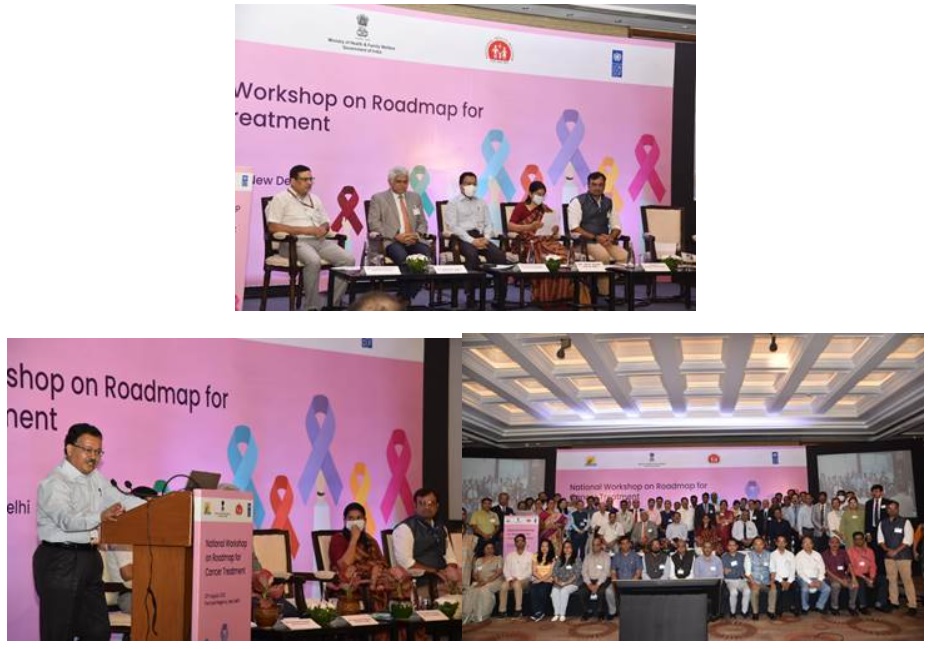
Further elaborating, Union Health Secretary pointed that the pandemic has taught us that health is not the exclusive responsibility of only the Union Health Ministry but jointly addressed by various Ministries at the Centre and through state governments. He added that health cannot reside only at the tertiary healthcare centers, but has a huge footprint in the primary and secondary levels too. Tertiary health facilities of Ministries such as Labour, Railways, Steel, ONGC, Atomic Energy etc., can be pooled to make a significantly large and sustainable network of healthcare for an exponential impact of healthcare delivery, he noted. Highlighting the paradigm change that the National health Mission (NHM) has recently undergone, he noted that not only primary and secondary healthcare services, but referrals with linkages to tertiary health services are being provided through a comprehensive end-to-end delivery solution.
Shri Rajesh Bhushan identified framing, sharing and adherence of evidence based common Standards of Protocols for critical care management as another learning for cancer management. These can guide the restructuring and refinement of the National Cancer Control Programme of Union Health Ministry, he noted. Capacity building of healthcare providers is required through regular training, retraining and skill enhancement for cancer care. He mentioned thatcapacity building also to be ensured with clear communication with all stakeholders and feedback procedures put in place. “We need to adapt and promote health technology and prevention and treatment of cancer such as telemedicine for improved access to care”, he stressed. Various “Hub and Spoke” models implemented in some states such as Assam, Punjab, Andhra Pradesh,Bihar can be emulated by other states, along with detailed mapping of the facilities with the granular planning of healthcare delivery, he suggested.
Sessions on the following topics were organized in the one-day national workshop organized by Union Health Ministry:
i. Infrastructure and human resources for Cancer Care in India
ii. Affordability of Cancer Care in India
iii. Best Practices with respect to cancer care by States
iv. Review of Ongoing Projects and its related issues
Ms. Roli Singh, AS & MD (NHM), Shri Vishal Chauhan, Joint Secretary (Policy), Dr Rajendra Badwe, Director, Tata Memorial Centre were also present at the event along with other senior officials from various states and medical institutes.
The National Health Authority (NHA) issued hardware guidelines across States and Union Territories for healthcare institutions like hospitals, clinics and health and wellness centres to promote digitization in hospitals. The guidelines provide a basic framework to States/UTs for planning, assessment and procurement of the IT hardware (including IT specifications of various hardware equipment) to operate applications compliant with Ayushman Bharat Digital Mission (ABDM).
Talking about the guidelines, Dr. R. S. Sharma, CEO, NHA said – “The first step towards ABDM implementation is digitization of hospitals. Several States and UTs expressed the need for some guidelines that gives them an overview of the IT infrastructure requirements based on the health facility size. The hardware guidelines issued by NHA will help the states/ UTs in assessing the requirement and facilitate the adoption of ABDM in their healthcare institutions.”
ABDM will simplify the processes and increase ease of living by connecting the digital health solutions of hospitals and other health facilities across the country with each other. The digital ecosystem will also enable a host of other facilities like teleconsultation, paper-less health records, QR code based OPD registrations etc. The digitization of health records will ensure that old medical records of patients cannot get lost and are accessible to them anytime anywhere. Ensuring necessary IT infrastructure and implementation of Hospital Information Management Systems across health facilities at the State/UT level will play a pivotal role in creation and exchange of digital health records across the ecosystem.
The guidelines on the IT hardware specifications to support this ecosystem is available at https://abdm.gov.in:8081/uploads/Hardware_Guidelines_ABDM_e162cf7a7b.pdf. The document will help the States/ UTs in assessing the hardware requirements while planning and procurement of IT assets for healthcare institutions of all scales. The guidelines published by NHA is suggestive and recommendatory in nature. States/UTs and the health facilities have the flexibility to modify these guidelines based on local requirements and circumstances.